Industrial clusters shape housing markets in ways that office parks do not. Engineering and defence employment tends to be long-tenured, well paid and...
Industrial clusters shape housing markets in ways that office parks do not. Engineering and defence employment tends to be long-tenured, well paid and geographically fixed, which produces steadier housing demand than sectors that relocate easily. Aerospace Park housing demand along the northern corridor follows that pattern, and it explains part of why this belt has behaved differently from others. Here is what the cluster comprises, who it employs, and how that translates into demand for homes nearby.
What the cluster comprises
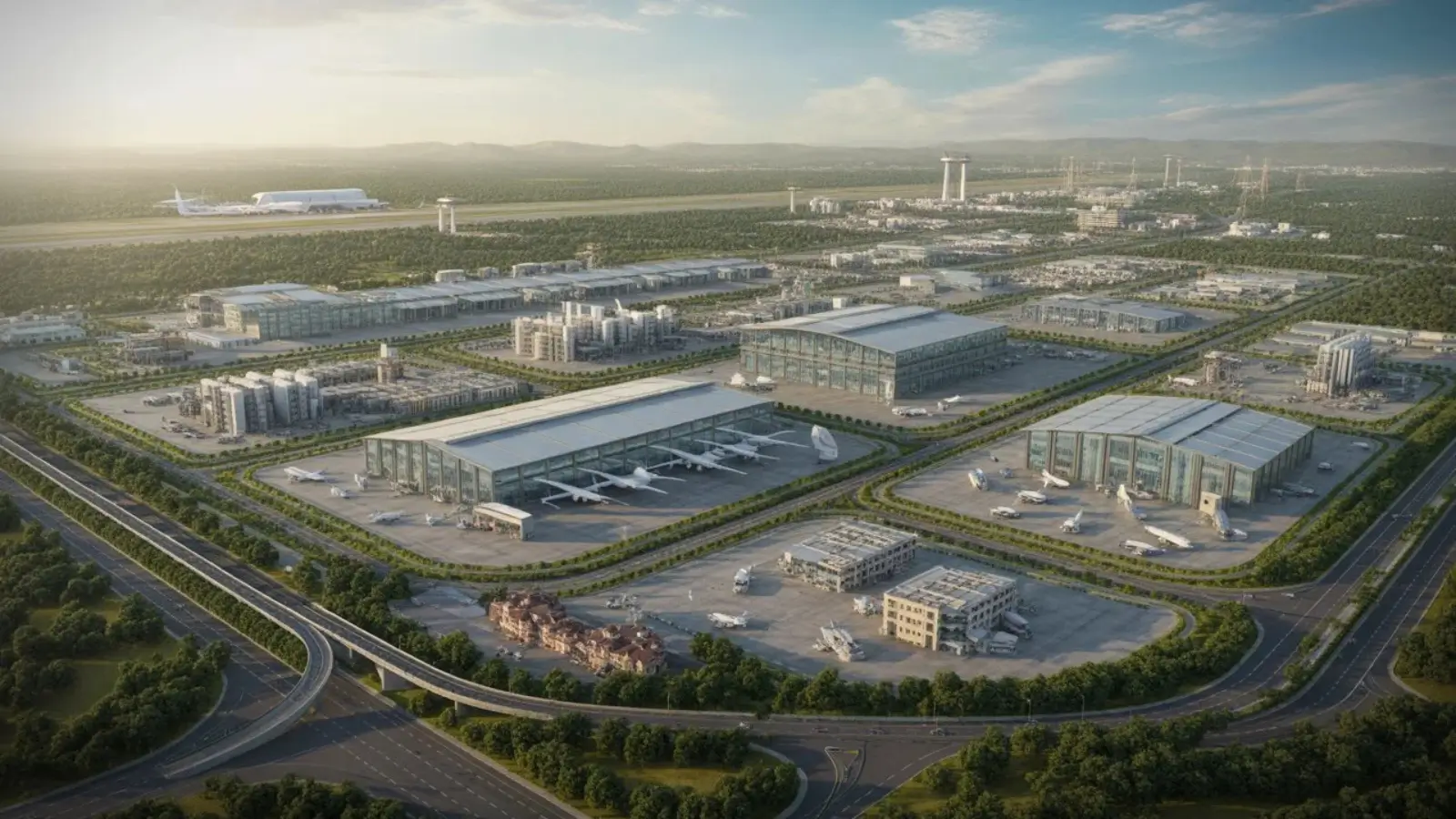
The KIADB special economic zone and the adjoining Aerospace Park cover roughly 3,000 acres, sitting about 10 km from the Tharahunise and Bettahalsur belt.
Scale of that order is unusual. A zone measured in thousands of acres implies long-term commitment from both government and occupiers rather than a speculative development.
Proximity matters for residents. Ten kilometres translates to a drive of roughly 16 to 20 minutes off-peak, which sits comfortably within a normal commuting range.
Industrial clusters take years to establish and rarely relocate. Aerospace Park housing demand therefore behaves differently from demand generated by office tenants who can move at lease expiry.
Long-lived industrial investment tends to anchor a location for decades. Facilities of this kind are expensive to build and correspondingly difficult to abandon.
Who it employs
Defence and engineering employment differs from general office work in several respects. Roles tend to be technical, specialised and tied to physical facilities rather than portable between cities.
That immobility works in a housing market's favour. Staff cannot easily work from another city, which anchors demand for homes within reach of the site.
Tenure tends to be longer as well. Engineering careers in defence and aerospace often run for years with one employer, producing stable rather than transient housing demand.
Supply chains follow anchor employers. Component manufacturers and service providers cluster nearby, multiplying the employment effect beyond the headline occupiers.
Skilled employment supports premium housing more reliably than volume employment does. Higher incomes translate into demand for better specification rather than simply more units.
Cluster employment also tends to grow incrementally rather than in sudden waves, which supports steadier housing demand.
Facilities of this scale also attract training institutes and skill centres, which broadens the local employment base further.
Employer cluster | Distance | Drive time |
|---|---|---|
KIADB Aerospace SEZ & Aerospace Park | ~10 km | 16–20 min |
IFCI Financial City | ~8 km | 14–16 min |
Devanahalli Business Park | ~11 km | 18–22 min |
Devanahalli Industrial Zone / ITIR | ~13 km | 20–24 min |
Kempegowda International Airport | ~14 km | 20–25 min |
Embassy Manyata Business Park | ~22 km | 38–45 min |
How it affects rental demand
Rental demand from technical staff forms a meaningful share of the local leasing market. Relocating engineers and managers typically seek quality housing within a short commute, often with company support.
Corporate housing budgets change what tenants prioritise. Security, amenity and a reputable address frequently outweigh a small difference in monthly rent.
Configuration preferences vary with seniority. Smaller homes suit individual relocations, while senior staff and families take larger formats and stay longer.
Shift patterns affect housing preferences too. Technical staff working non-standard hours often prioritise a short commute above almost everything else.
Ancillary employment often exceeds direct employment. Suppliers, contractors and services around an anchor cluster employ substantial numbers themselves.
Why diversity matters more than scale
Employment diversity on the corridor is what distinguishes this belt. Aerospace and defence sit alongside financial services at IFCI Financial City, IT at Devanahalli Business Park and manufacturing in the industrial zone.
Single-industry towns are vulnerable to a downturn in that industry. Four sectors within about 13 km spread the risk, which supports both occupancy and pricing through cycles.
That mix has developed over years rather than arriving at once, which suggests it is structural rather than a temporary clustering.
Family relocation drives demand for larger homes. Engineers moving with school-age children look for three-bedroom formats near good schools.
Schools matter to this cohort in particular. Families relocating for technical roles tend to prioritise education access when choosing where to live.
Dual-income households often find two roles within the same belt, which strengthens their attachment to the area.
Commute tolerance is higher among technical staff working fixed shifts, which widens the catchment for housing nearby.
Housing quality influences recruitment for employers too, which is why clusters of this kind tend to attract residential development nearby.
What it means for an owner
For an owner-occupier, the practical benefit is a short commute to a growing set of employers. Roles in several sectors sit within twenty minutes of home.
For an investor, the benefit is tenant depth. A market drawing from four industries is less likely to see prolonged vacancy than one dependent on a single employer.
Concentration within one belt does carry some risk. A slowdown across aerospace and defence would affect this corridor more than a diversified city location.
Policy support can change, which is worth acknowledging. Special economic zones operate within frameworks that governments periodically revise.
The caveats
Employment growth is a forecast rather than a fact. Corridor projections of around 12% for 2026 are described as contingent on employment commissioning, which is an honest acknowledgement of uncertainty.
Supply is the other variable. More than 15,000 units are planned across the wider belt, and rental markets respond to new stock as much as to new jobs.
Our team can talk through both the employment case and its limits, which is a more useful conversation than a list of nearby companies.
Watch commissioning announcements rather than acreage figures. Land allocated matters less than facilities actually operating and hiring.
Our team can set out which employers sit within each distance band, so the commute calculation reflects your actual workplace.
Ask our team which employers sit within your acceptable commute, then judge the address on that basis.
Employment depth is the foundation of any rental market, and it is worth assessing before amenity or specification.
Jobs anchor housing markets more durably than any single amenity does.
Karnataka RERA Registration No. PRM/KA/RERA/1251/309/PR/090926/008925. To check availability, current pricing or to arrange a site visit, get in touch with our team.
FAQs
How large is the aerospace cluster?
The KIADB Aerospace SEZ and Aerospace Park cover roughly 3,000 acres, about 10 km from the Tharahunise belt.How long is the commute?
Around 16 to 20 minutes off-peak over about 10 km.Why does this employment matter?
Technical and defence roles are tied to physical facilities, which anchors housing demand nearby.Who rents in this market?
Relocating engineers, managers and senior technical staff, often with company housing support.What other employers are nearby?
IFCI Financial City at about 8 km, Devanahalli Business Park at about 11 km and the industrial zone at roughly 13 km.Does diversity reduce risk?
Yes. Four sectors within about 13 km spread demand more safely than a single-industry base.Will employment keep growing?
Corridor projections assume continued commissioning, which is a forecast rather than a certainty.Does new supply affect rents?
It can. More than 15,000 planned units across the belt will influence how rental markets behave.
Related Articles

Embassy South Reserve Review: An Honest Assessment
Nobody lives here yet, and possession is set for 2032, so any Embassy South Reserve review has to work from documents rather than experience. That...

The Embassy South Reserve Booking Process, Step by Step
Buying a home is a sequence of decisions rather than a single one, and knowing the order keeps control where it belongs. Expression-of-interest holders...
Embassy South Reserve Cost Sheet: Every Line Explained
Rs 1.92 Cr buys a 2 BHK here, or so the headline says. What leaves your account is another figure entirely, and the gap between the two runs to lakhs...

Checking the Embassy South Reserve RERA Registration
A registration number on a brochure proves very little by itself. Behind it sits a filing on a public portal, and that filing is what actually protects...