Industrial employment rarely features in property marketing, which tends to favour glass office towers over factory floors. That omission misses...
Industrial employment rarely features in property marketing, which tends to favour glass office towers over factory floors. That omission misses something important. Manufacturing and engineering jobs are geographically fixed, long-tenured and well paid, which makes them unusually reliable anchors for housing demand. The Devanahalli SEZ and industrial jobs around the northern corridor illustrate the point clearly. This guide covers what a special economic zone actually is, which clusters operate here, and how industrial employment shapes the housing market around it.
What a special economic zone is
Special economic zone basics are worth establishing first. These are designated areas operating under distinct regulatory and fiscal frameworks intended to attract investment and employment.
Governments create them to concentrate industrial activity, and companies locate within them for the operating conditions they provide.
Zones of this kind involve long-term commitments on both sides, since the infrastructure required is expensive and difficult to relocate once built.
Fiscal and regulatory frameworks also give occupiers reasons to stay once established, which supports continuity.
Infrastructure inside such zones is typically provided as part of the designation, which lowers the barrier for occupiers.
Employment concentrated in designated zones also simplifies transport planning, since commuting patterns become predictable.
Long-term commitments from both government and occupiers make such zones unusually durable anchors for local demand.
Zones of this scale also attract training institutes and skill centres, which broadens the employment base further.
The aerospace cluster
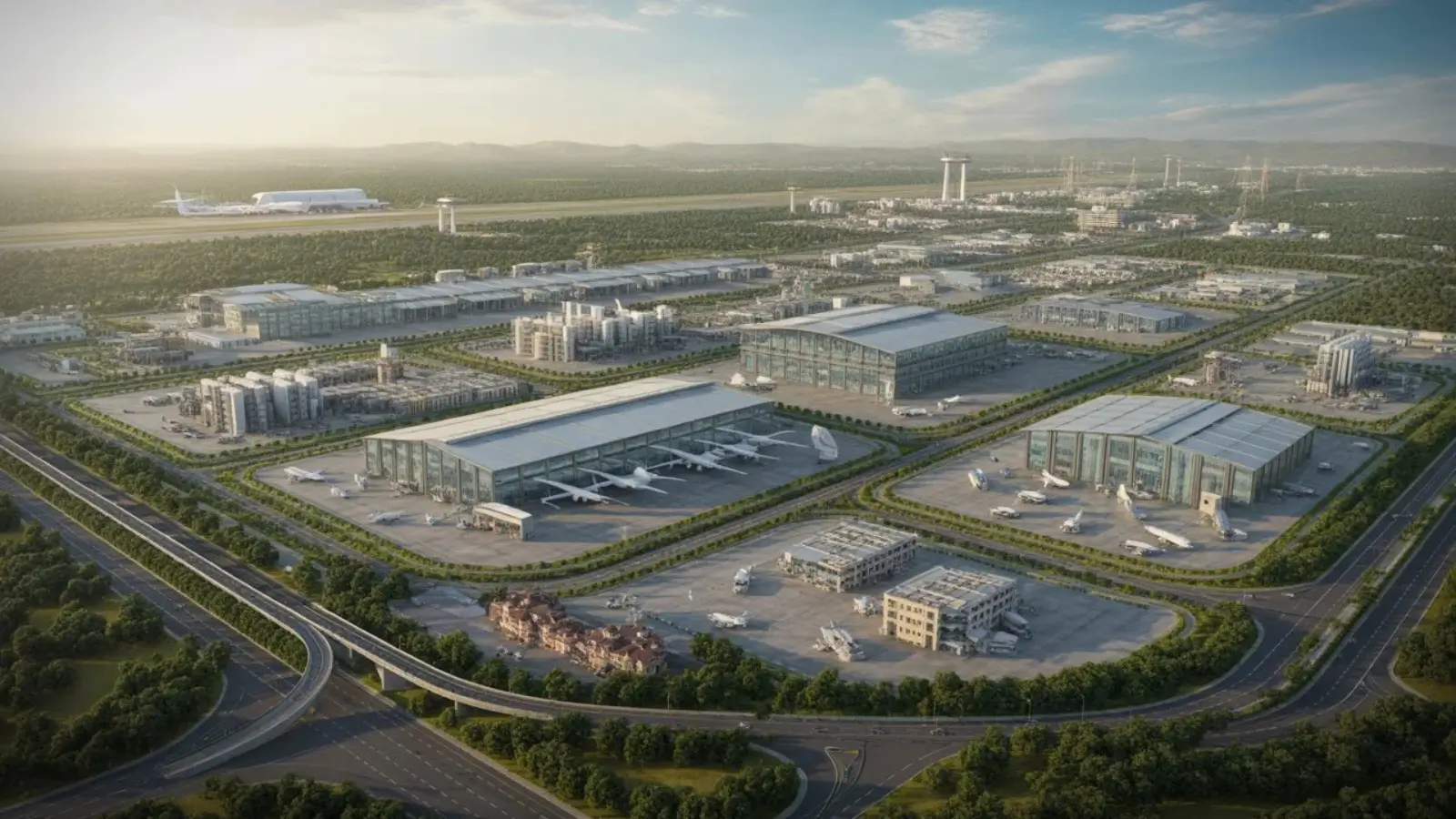
The aerospace and defence cluster anchors the corridor's industrial base. Covering roughly 3,000 acres, the KIADB Aerospace SEZ and Aerospace Park sit about 10 km from the Tharahunise belt.
Acreage on that scale signals intent rather than experiment. A zone measured in thousands of acres implies sustained commitment from both government and occupiers.
Employment here is technical and specialised, which produces households with higher incomes and longer tenures than many other sectors generate.
Ancillary employment adds to the direct figures, since suppliers and contractors cluster around anchor facilities.
Technical roles also tend to pay above regional averages, which supports demand for premium rather than mid-market housing.
Specialised roles are harder to fill, which encourages employers to support relocation with housing allowances.
Higher incomes also support the amenity-led developments that have appeared along this belt in recent years.
Cluster | Distance | Drive time |
|---|---|---|
KIADB Aerospace SEZ & Aerospace Park | ~10 km | 16–20 min |
IFCI Financial City | ~8 km | 14–16 min |
Prestige Tech Cloud | ~9 km | 15–18 min |
Devanahalli Business Park | ~11 km | 18–22 min |
Devanahalli Industrial Zone / ITIR | ~13 km | 20–24 min |
Kempegowda International Airport | ~14 km | 20–25 min |
Manufacturing and electronics
Manufacturing and electronics occupy the Devanahalli industrial zone, roughly 13 km from the belt, alongside the wider information technology investment region designation.
New-economy manufacturing has grown here since 2024, adding a cohort of workers that barely existed in the area five years earlier.
Corporate relocations into the belt have reinforced that, bringing management and technical staff who need housing within a reasonable commute.
Information technology investment region designations bring further planning support to the wider area.
Electronics manufacturing has expanded nationally in recent years, and the Devanahalli belt has captured part of that growth.
Corporate relocations have brought management staff who previously lived in other parts of the city entirely.
Airport proximity supports logistics activity too, which adds another layer of employment nearby.
Electronics and precision manufacturing both require skilled staff, which raises average incomes across the area.
How industrial jobs differ
Portability is the key difference. Office work can shift between cities or move partly online, whereas manufacturing and engineering roles are tied to facilities that cannot relocate easily.
Tenure tends to be longer as well. Careers in aerospace, defence and manufacturing often run for years with one employer rather than turning over rapidly.
Shift patterns also affect housing choices, since staff working non-standard hours place particular value on short commutes.
Considering Devanahalli SEZ and industrial jobs together explains why housing demand here has held steadier than the airport alone would suggest.
Facilities of this kind are expensive to build and correspondingly difficult to abandon, which anchors an area for decades.
Longer tenures also mean households are more likely to buy rather than rent indefinitely.
Fixed facilities also mean employment persists through cycles that would see office tenants relocate or reduce space.
What jobs mean for housing
Rental demand shows the clearest effect of what jobs mean for housing. Technical staff relocating for work need quality housing within reach, often with employer support.
Purchase demand follows a few years later, once households settle and decide to stay in the area rather than treating it as a posting.
Family requirements shape what gets built. Engineers relocating with school-age children look for larger homes near good schools, which influences configuration mixes across the corridor.
School proximity matters to relocating families, which influences where within a corridor demand concentrates.
Purchase demand generally follows rental demand by a few years, once households decide to settle rather than rotate.
Configuration demand shifts accordingly, with three-bedroom formats favoured by relocating families.
Schools within a short radius influence where relocating families choose to live within a corridor.
Households that arrive on a posting and then decide to stay are a meaningful part of local purchase demand.
The caveats
Employment projections are forecasts rather than facts. Corridor growth of around 12% for 2026 is described as contingent on employment commissioning, which is an honest acknowledgement.
Policy frameworks around special economic zones are also revised periodically by governments, which introduces a variable outside any developer's control.
Our team can set out which employers are operating today rather than which have been announced, since the distinction matters when assessing an address.
Operating facilities matter more than announced ones when assessing an address, so ask which is which.
Policy frameworks can change, which is a variable worth acknowledging rather than ignoring.
Employment forecasts remain forecasts, and a sound purchase should work even if hiring runs slower than projected.
Operating employers can be verified, whereas announcements cannot, which is the distinction that protects a buyer.
Karnataka RERA Registration No. PRM/KA/RERA/1251/309/PR/090926/008925. To check availability, current pricing or to arrange a site visit, get in touch with our team.
FAQs
How large is the aerospace zone?
Covering roughly 3,000 acres, the KIADB Aerospace SEZ and Aerospace Park sit about 10 km from the Tharahunise belt.What is a special economic zone?
A designated area operating under distinct regulatory and fiscal frameworks intended to attract investment and employment.Which other employers are nearby?
IFCI Financial City at about 8 km, Devanahalli Business Park at about 11 km and the industrial zone at roughly 13 km.Why do industrial jobs matter?
They are tied to physical facilities, which anchors housing demand more firmly than portable office work.Is tenure longer in these sectors?
Engineering and defence careers often run for years with one employer, producing stable housing demand.How does this affect rentals?
Relocating technical staff generate steady demand, frequently with employer housing support.Will employment keep growing?
Corridor projections assume continued commissioning, which is a forecast rather than a certainty.What should I verify?
Which employers are operating and hiring today rather than which facilities have been announced.
Related Articles

Embassy South Reserve Review: An Honest Assessment
Nobody lives here yet, and possession is set for 2032, so any Embassy South Reserve review has to work from documents rather than experience. That...

The Embassy South Reserve Booking Process, Step by Step
Buying a home is a sequence of decisions rather than a single one, and knowing the order keeps control where it belongs. Expression-of-interest holders...

Embassy South Reserve Cost Sheet: Every Line Explained
Rs 1.92 Cr buys a 2 BHK here, or so the headline says. What leaves your account is another figure entirely, and the gap between the two runs to lakhs...

Checking the Embassy South Reserve RERA Registration
A registration number on a brochure proves very little by itself. Behind it sits a filing on a public portal, and that filing is what actually protects...