
Six years is a long time to hold a property you cannot occupy, and any honest discussion of this project has to begin there. Embassy South Reserve...
Six years is a long time to hold a property you cannot occupy, and any honest discussion of this project has to begin there. Embassy South Reserve possession is set for 2032, which suits some households and rules the project out for others. The date is more than an intention, though. It sits in a regulatory filing and in the agreement to sell, with consequences attached to both. Here is what that commitment covers, how to follow progress towards it, and which buyers the timeline genuinely fits.
Where the date is recorded
Two documents carry the handover commitment under RERA: the Karnataka RERA filing and the agreement to sell. Both matter, and both should show the same year.
Read them yourself rather than accepting a summary. Any difference between the filed date and the contractual date is a question to raise before signing rather than afterwards.
Both documents should also match your own understanding. Where a conversation has suggested an earlier date, the written record is what counts, and it is worth saying so politely at the time.
Filed dates and contractual dates should agree, and usually do. Checking takes a moment, and a mismatch is far easier to resolve before signature than after.
What happens if delivery slips
Penalty clauses for delay form part of the agreement, covering handover that runs late without justification. Buyers also hold direct legal recourse with defined adjudication timelines.
Those provisions repay careful reading. They set out what compensation applies and over what period, turning an abstract promise into something with a defined financial consequence attached to it.
Compensation provisions repay careful reading. They set out what applies and over what period, which converts an abstract commitment into a defined financial consequence rather than a general assurance.
Legal recourse exists precisely because delay is possible. Knowing the remedy in advance is preferable to discovering it during an argument several years from now.
Adjudication timelines are defined rather than open-ended, which matters. A remedy that takes years to obtain is worth considerably less than one with a fixed process attached to it.
Milestone | Status |
|---|---|
Karnataka RERA registration | Issued — PRM/KA/RERA/1251/309/PR/090926/008925 |
Booking | Open, with early registrations in priority order |
Construction | Follows registration |
Progress filings | Published quarterly on the K-RERA portal |
Possession | 2032 |
Following progress in the meantime
Quarterly progress disclosures are filed on the portal throughout construction, so owners can follow the build without relying on anyone's assurance. Reading each one takes minutes.
Filings are cumulative, which makes them more useful in sequence than individually. Pace, rather than position at a single moment, is what tells you whether a 2032 handover still looks realistic.
Progress filings record specification changes as well. Because any deviation triggers fresh disclosure under RERA, the portal doubles as a record of what is actually being built rather than merely how fast.
Pace across consecutive filings tells you more than any single one. A steady sequence suggests a build on track; two flat quarters suggest a conversation is due.
What happens after handover
Protection does not stop at possession. A five-year defect liability period covers structural and material issues, placing responsibility for early faults with the developer rather than the owner.
Handover also brings practical steps of its own: snagging, documentation, khata transfer and the start of maintenance charges. Budget for that phase as carefully as for the construction years themselves.
Maintenance charges begin at handover too. Budget for them from 2032 onwards, since a township of this scale carries running costs that a standalone building does not.
Snagging deserves proper attention when the time comes. The defect liability period gives a new owner recourse, but a careful inspection at handover makes using it far simpler.
Khata transfer and documentation follow handover rather than preceding it. Allowing time and budget for that phase avoids an unwelcome scramble at the end.
Who the timeline fits
Considering who a long timeline suits produces a clear answer. End-users planning a move several years out gain time to arrange finances, while investors underwriting income from 2032 onward buy at launch-stage pricing for that reason.
Anyone needing occupation within two years does not fit, and no amount of specification changes that. Ready or near-complete inventory elsewhere on the corridor serves that household considerably better.
Between the two extremes sit households with flexible timing, for whom Embassy South Reserve possession in 2032 is a question of return rather than necessity. A long window suits them, provided the holding cost is modelled honestly.
Investors in that position should price the gap honestly. Nothing comes in from the asset until 2032, so the return has to come from appreciation alone across the construction years.
Flexible buyers gain the most from a long window. Those who can wait use the construction years to arrange finances, while those who cannot are better served by ready inventory elsewhere on the corridor.
What the wait costs and what it buys
Rental income begins only after handover, so the intervening years rest wholly on capital appreciation. Comparable corridor launches have historically delivered 20–30% across a full pre-launch-to-possession cycle.
Payments meanwhile spread across the construction period rather than landing at once, which eases cash flow. Six years also gives infrastructure time to arrive, since Doddajala Metro Station, the STRR and the Peripheral Ring Road are all in execution.
Align your own dates with the project's. School admissions, lease expiries and loan tenures each carry their own timing, and matching them to a 2032 handover is easier decided now than negotiated later.
Six years also gives the surrounding infrastructure time to arrive. Should the metro and the ring roads open within that window, the address in 2032 will not be the address of today.
Payments spread across six years rather than landing at once, which eases the burden considerably. That staging is part of what makes a long timeline workable for many households.
Our team can give a realistic view rather than an optimistic one. A committed date carries obligations, and any responsible conversation covers both outcomes.
Karnataka RERA Registration No. PRM/KA/RERA/1251/309/PR/090926/008925. To check availability, current pricing or to arrange a site visit, get in touch with our team.
FAQs
When is handover?
2032, as filed with Karnataka RERA and recorded in the agreement to sell.What if the date slips?
The agreement carries penalty clauses for unjustified delay, and buyers hold direct legal recourse with defined timelines.How do I track construction?
Through quarterly progress disclosures published on the K-RERA portal against the project's registration.Is there cover after possession?
Yes. A five-year defect liability period covers structural and material issues.Can I let the home before 2032?
No. Rental income begins only after possession, so the holding case rests on appreciation until then.Does a long build mean higher risk?
It means a longer horizon. Registration, escrow segregation and quarterly filings are the mechanisms that manage that risk.What costs arrive at handover?
Registration and stamp duty, along with snagging, documentation, khata transfer and the start of maintenance charges.Who benefits most from the timeline?
Buyers with flexible timing who can use the construction years to plan finances or hold for appreciation.
Related Articles

Embassy South Reserve Review: An Honest Assessment
Nobody lives here yet, and possession is set for 2032, so any Embassy South Reserve review has to work from documents rather than experience. That...

The Embassy South Reserve Booking Process, Step by Step
Buying a home is a sequence of decisions rather than a single one, and knowing the order keeps control where it belongs. Expression-of-interest holders...
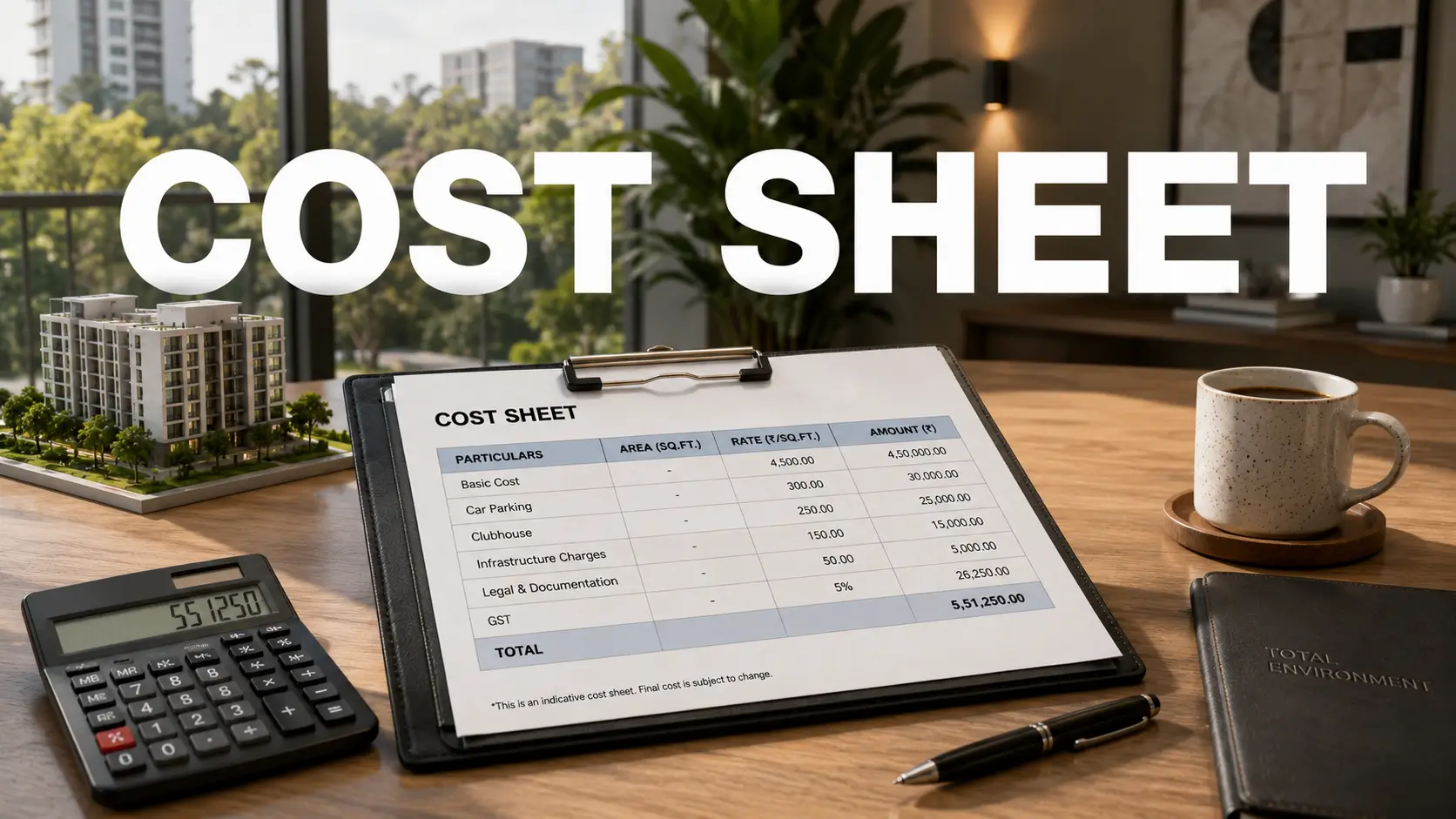
Embassy South Reserve Cost Sheet: Every Line Explained
Rs 1.92 Cr buys a 2 BHK here, or so the headline says. What leaves your account is another figure entirely, and the gap between the two runs to lakhs...

Checking the Embassy South Reserve RERA Registration
A registration number on a brochure proves very little by itself. Behind it sits a filing on a public portal, and that filing is what actually protects...