Investment questions deserve arithmetic rather than enthusiasm. Asking is Embassy South Reserve a good investment means testing four things: what the...
Investment questions deserve arithmetic rather than enthusiasm. Asking is Embassy South Reserve a good investment means testing four things: what the corridor has done, what the project costs to enter, what it might earn once let, and what could go wrong in between. None of those answers is a guarantee, and anyone promising otherwise is selling rather than advising. What follows sets out the figures available today, the assumptions behind them, and the horizon over which this particular purchase makes sense.
What the corridor has delivered
Appreciation on the airport corridor has been strong over the past six years. Compounding ran at roughly 13.5% a year between 2020 and 2026, ahead of Whitefield at about 10%, Sarjapur Road at about 11% and Electronic City at about 9%.
Shorter windows tell a similar story. Values rose about 11.8% over one year, roughly 57% across three years and around 73% across five, with branded launches adding about 20% through 2025 alone.
Those figures describe the belt rather than any single project. A buyer should treat them as context, since individual addresses vary considerably within the same corridor.
Read those numbers as belt-wide evidence rather than a project forecast. Whether it is Embassy South Reserve a good investment case that suits you turns on entry cost, horizon and the rent a specific home eventually commands.
Ten-year data reinforces the pattern, with appreciation of roughly 109% across that period. Long records matter more than recent quarters when assessing whether a belt has structural support.
| Measure | Figure |
|---|---|
| One-year appreciation | ~11.8% |
| Three-year appreciation | ~57% |
| Five-year appreciation | ~73% |
| Ten-year appreciation | ~109% |
| Compound growth, 2020–2026 | ~13.5% a year |
| Projected growth, 2026 | ~12% |
| Outlook in stable conditions | 12–15% a year |
What entry costs today
Entry price and holding period work together, so both belong in the same calculation. A 2 BHK opens at Rs 1.92 Cr, a 2.5 BHK at Rs 2.29 Cr and a 3 BHK at Rs 2.77 Cr, with the 3.5 BHK released on request.
Tax lifts those figures materially. GST at 5% and stamp duty with registration at roughly 7.65% take an indicative all-in cost to about Rs 2.16 Cr, Rs 2.58 Cr and Rs 3.12 Cr respectively.
Model returns on the all-in number. Basing a yield or appreciation calculation on the base price alone overstates performance by more than a tenth before any other charge is counted.
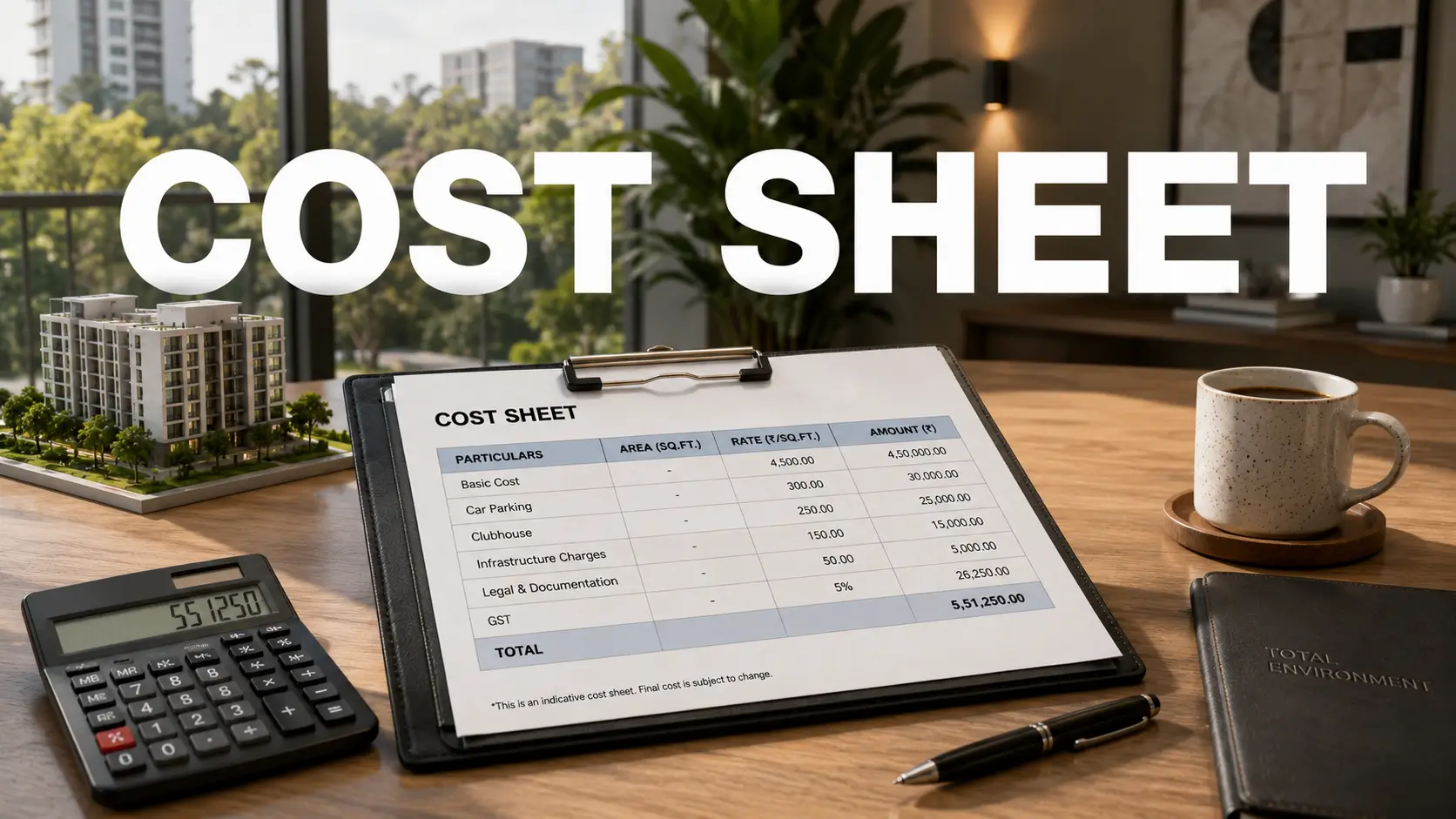
Charges beyond tax lift the figure further. Floor rise, preferred location, club membership, corpus and parking all sit on the cost sheet and all reduce the return a headline price implies.
Cost sheets differ by unit, so build the model on the one issued for your apartment. A generic price list cannot tell you what a corner home on a high floor will actually cost.
What it might earn
Rental yield expectations on this corridor run at 3.5 to 4% of property cost a year for semi-furnished homes, and 4 to 4.5% when furnished.
Applied to current entry prices, a semi-furnished 2 BHK points to roughly Rs 56,000 to Rs 64,000 a month, and a 3 BHK to about Rs 80,800 to Rs 92,300. Furnishing adds around half a percentage point of yield.
Nothing arrives before 2032, however. Possession sits six years out, so the entire holding period until then rests on capital appreciation rather than income.
Furnishing is the one lever an owner controls directly. Moving from semi-furnished to furnished adds roughly half a percentage point, which suits corporate tenancies turning over regularly.
Configuration affects income as much as size does. Smaller homes typically achieve higher yields on cost, while larger ones deliver higher absolute rent.
How the numbers might stack up
Comparable launches on this corridor have historically delivered 20 to 30% across a full pre-launch-to-possession cycle. Annual appreciation under stable conditions is projected at 12 to 15%.
Those are historic patterns rather than commitments. Applying them mechanically to a six-year hold produces a wide range of outcomes depending on which end of each band actually materialises.
Sensitivity testing beats point forecasts. Running the lower end of each band shows whether a purchase still works when conditions disappoint rather than only when they cooperate.
Scenario planning helps more than precision here. Model a weak case, a central case and a strong one, then check whether the weak case is survivable.
Risks worth pricing in
Four risks worth pricing in stand out. Entry sits at the top of the corridor band, which narrows the appreciation runway compared with buying lower on the same belt.
Handover is six years away, several transport projects remain under execution rather than in service, and more than 15,000 units are planned across the wider Devanahalli belt.
None of those is disqualifying. Each simply belongs in the model, and a purchase that only works if every variable behaves well is a purchase worth reconsidering.
Registration mitigates part of the delivery risk. Escrow segregation, quarterly filings and a committed possession date give a buyer recourse that unregistered offers cannot.
Concentration risk deserves a mention as well. A household placing most of its net worth in one apartment carries exposure that no corridor analysis removes.
The honest verdict
For a buyer holding across a full cycle, the case rests on a corridor with genuine employment, an established growth record and a project offering specification the belt does not otherwise supply.
Anyone planning a short hold or needing income soon should reach a different conclusion. Six years without rent changes the arithmetic entirely, and no amount of specification compensates for that.
Our team can run the numbers against your own assumptions rather than ours, including the charges that lift the real entry cost. That exercise usually settles the question faster than any general argument.
Transaction costs also argue for patience. Roughly 12.65% in tax and registration has to be recovered before any gain becomes real, which short holds rarely manage.
Our team can run those scenarios with you using the actual cost sheet, which produces a far more useful conversation than percentages applied to a headline price.
Karnataka RERA Registration No. PRM/KA/RERA/1251/309/PR/090926/008925. To check availability, current pricing or to arrange a site visit, get in touch with our team.
FAQs
What returns has the corridor produced?
Roughly 13.5% a year between 2020 and 2026, with about 11.8% over the most recent year.What rental yield is realistic?
Between 3.5 and 4% of property cost a year semi-furnished, and 4 to 4.5% furnished, once homes are handed over.When would rental income begin?
After possession in 2032. Until then the holding case rests entirely on capital appreciation.What does a 3 BHK cost all-in?
About Rs 3.12 Cr once GST and stamp duty are added to the Rs 2.77 Cr base price, before other charges.What is the biggest risk?
A combination of top-of-band entry pricing, a six-year wait and more than 15,000 planned units across the belt.Is the project registered?
Yes, under Karnataka RERA number PRM/KA/RERA/1251/309/PR/090926/008925, which records sanctioned plans and the possession date.What holding period suits this purchase?
A full cycle. Short holds struggle to absorb transaction costs and the years before income begins.Should I model on the base price?
No. Use the all-in figure including GST, stamp duty and cost-sheet charges.
Related Articles

Embassy South Reserve Review: An Honest Assessment
Nobody lives here yet, and possession is set for 2032, so any Embassy South Reserve review has to work from documents rather than experience. That...

The Embassy South Reserve Booking Process, Step by Step
Buying a home is a sequence of decisions rather than a single one, and knowing the order keeps control where it belongs. Expression-of-interest holders...
Embassy South Reserve Cost Sheet: Every Line Explained
Rs 1.92 Cr buys a 2 BHK here, or so the headline says. What leaves your account is another figure entirely, and the gap between the two runs to lakhs...

Checking the Embassy South Reserve RERA Registration
A registration number on a brochure proves very little by itself. Behind it sits a filing on a public portal, and that filing is what actually protects...