NRI Investment in North Bangalore: Returns and Practicalities
Investing across borders adds two variables to every property decision: currency and distance. Neither is insurmountable, though both deserve planning...
Investing across borders adds two variables to every property decision: currency and distance. Neither is insurmountable, though both deserve planning rather than optimism. NRI investment in North Bangalore has grown alongside the corridor's employment base, and the arithmetic looks different in dollars than it does in rupees. This guide covers what an apartment costs in foreign currency terms, what it might return, how a property is managed from abroad, and what to settle before an eventual sale.
What it costs in dollar terms
Converting helps overseas buyers benchmark against home markets. At an assumed Rs 88 to the US dollar, the dollar cost of an apartment here runs to roughly USD 218,000 for a 2 BHK, USD 260,000 for a 2.5 BHK and USD 315,000 for a 3 BHK.
Exchange rates move, so those figures should be re-derived at the time of transaction. A five percent currency shift changes the effective price more than most negotiations do.
Set against premium apartment markets in Dubai, Singapore or US gateway cities at comparable specification levels, the absolute numbers are modest before any currency consideration enters the picture.
Currency movement cuts both ways over a long hold. NRI investment in North Bangalore rewards buyers who model outcomes in both rupees and their home currency rather than one alone.
Overseas buyers face a choice between markets as well as assets. Comparing an Indian purchase against local property requires converting both to the same currency and the same tax basis.
| Configuration | Rupee price | Approximate USD at Rs 88 |
|---|---|---|
| 2 BHK | Rs 1.92 Cr | ~USD 218,000 |
| 2.5 BHK | Rs 2.29 Cr | ~USD 260,000 |
| 3 BHK | Rs 2.77 Cr | ~USD 315,000 |
| 3.5 BHK | On request | — |
Returns to expect
Yield and appreciation for overseas buyers follow the same bands as for residents. Semi-furnished homes on this corridor typically yield 3.5 to 4% of property cost a year, and furnished homes 4 to 4.5%.
Appreciation has been the larger component. The belt compounded at roughly 13.5% a year between 2020 and 2026, with projections of 12 to 15% under stable conditions.
Currency movement sits on top of both. A rupee that weakens against your home currency reduces returns when converted back, which is why overseas investors should model in both currencies.
Rental income accrues in rupees regardless of where an owner lives. Converting it periodically rather than annually smooths some of the exchange rate variation.
Remittance timing affects the effective price paid. Sending funds across several tranches averages the exchange rate rather than betting on a single day.
Holding costs accumulate quietly during construction. Maintenance begins at handover, but loan interest and opportunity cost run from the first payment.
Why the corridor attracts overseas buyers
Airport proximity is the obvious draw, with the terminal about 14 km from the Tharahunise belt. Owners who fly in occasionally value a short run at the end of a long flight.
Employment underpins the rental case. Aerospace, financial services, IT and airport-services employers within about 13 km generate corporate leasing demand that supports occupancy.
Regulatory protection matters too. A registered project places sanctioned plans, milestone timelines and inventory on a public portal, which is particularly useful when you cannot inspect in person.
Regulatory transparency matters more from a distance. Being able to read sanctioned plans and progress filings online removes much of the uncertainty that deters remote buyers.
Communication with a developer becomes simpler once a project is registered. Public filings answer many questions that would otherwise require a phone call across time zones.
Managing a property from abroad
Managing a property from abroad is easier in a township than in a standalone building. Security, maintenance and common services are handled by the development rather than by an individual owner.
Letting still requires someone local. A property manager or an agent handling tenant selection, rent collection and maintenance requests removes most of the practical burden.
Documentation should be organised from the outset. Keeping agreements, receipts and correspondence in one accessible place saves considerable difficulty when acting across time zones.
Visiting occasionally remains worthwhile despite good management. Owners who see their asset once every year or two tend to catch issues earlier.
Property management fees vary widely. Compare what each manager actually does rather than only what each charges.
Tenancy agreements should be reviewed by someone locally before signing. Standard templates vary in how well they protect an absent owner.
Funding and compliance
Purchases run through NRE, NRO or FCNR accounts or inward remittance, under the general permission route for residential property. Home loans are available subject to lender criteria.
A power of attorney allows formalities to be completed without travelling. Preparing one takes time where attestation abroad is required, so begin early rather than at a payment deadline.
Lender requirements for non-resident borrowers differ from those for residents. Confirm documentation and repayment terms before committing to a milestone schedule.
Insurance for a let property is worth arranging from the outset. Remote owners have fewer opportunities to notice problems early.
Planning the exit
Exit and repatriation planning belongs at the start rather than the end. Sale proceeds may generally be repatriated subject to prevailing FEMA norms, conditions and limits.
Tax treatment differs for non-residents, including withholding on a sale, and treaty provisions may apply depending on your country of residence. A tax adviser should confirm your position before you buy.
Timing matters as well. With possession set for 2032, an overseas investor should plan for six years without rental income and model the holding cost accordingly.
Succession planning deserves attention alongside tax. Cross-border estates are considerably simpler when arrangements are documented at purchase.
Our team can outline what an overseas owner typically needs in place before handover, so nothing is arranged in a rush at the end.
Ask us what practical support an overseas owner typically needs, from handover onwards.
Karnataka RERA Registration No. PRM/KA/RERA/1251/309/PR/090926/008925. To check availability, current pricing or to arrange a site visit, get in touch with our team.
FAQs
What does a 3 BHK cost in dollars?
Roughly USD 315,000 at an assumed Rs 88 to the dollar, though rates move and should be re-checked.What returns are realistic?
Yields of 3.5 to 4.5% a year once let, alongside corridor appreciation that compounded at about 13.5% a year from 2020 to 2026.How is currency risk handled?
Model returns in both currencies, since a weaker rupee reduces proceeds when converted back.Can I manage the home remotely?
Yes. Township security and maintenance are handled by the development, and a local manager can handle letting.How do I fund the purchase?
Through NRE, NRO or FCNR accounts or inward remittance, with home loans available subject to criteria.Can I repatriate sale proceeds?
Generally yes, subject to prevailing FEMA norms, conditions and limits.When would rental income start?
After possession in 2032, so plan for six years of outgoings without income.Do I need Indian tax advice?
Yes. Withholding and treaty positions differ for non-residents and should be settled before purchase.
Related Articles

Embassy South Reserve Review: An Honest Assessment
Nobody lives here yet, and possession is set for 2032, so any Embassy South Reserve review has to work from documents rather than experience. That...

The Embassy South Reserve Booking Process, Step by Step
Buying a home is a sequence of decisions rather than a single one, and knowing the order keeps control where it belongs. Expression-of-interest holders...
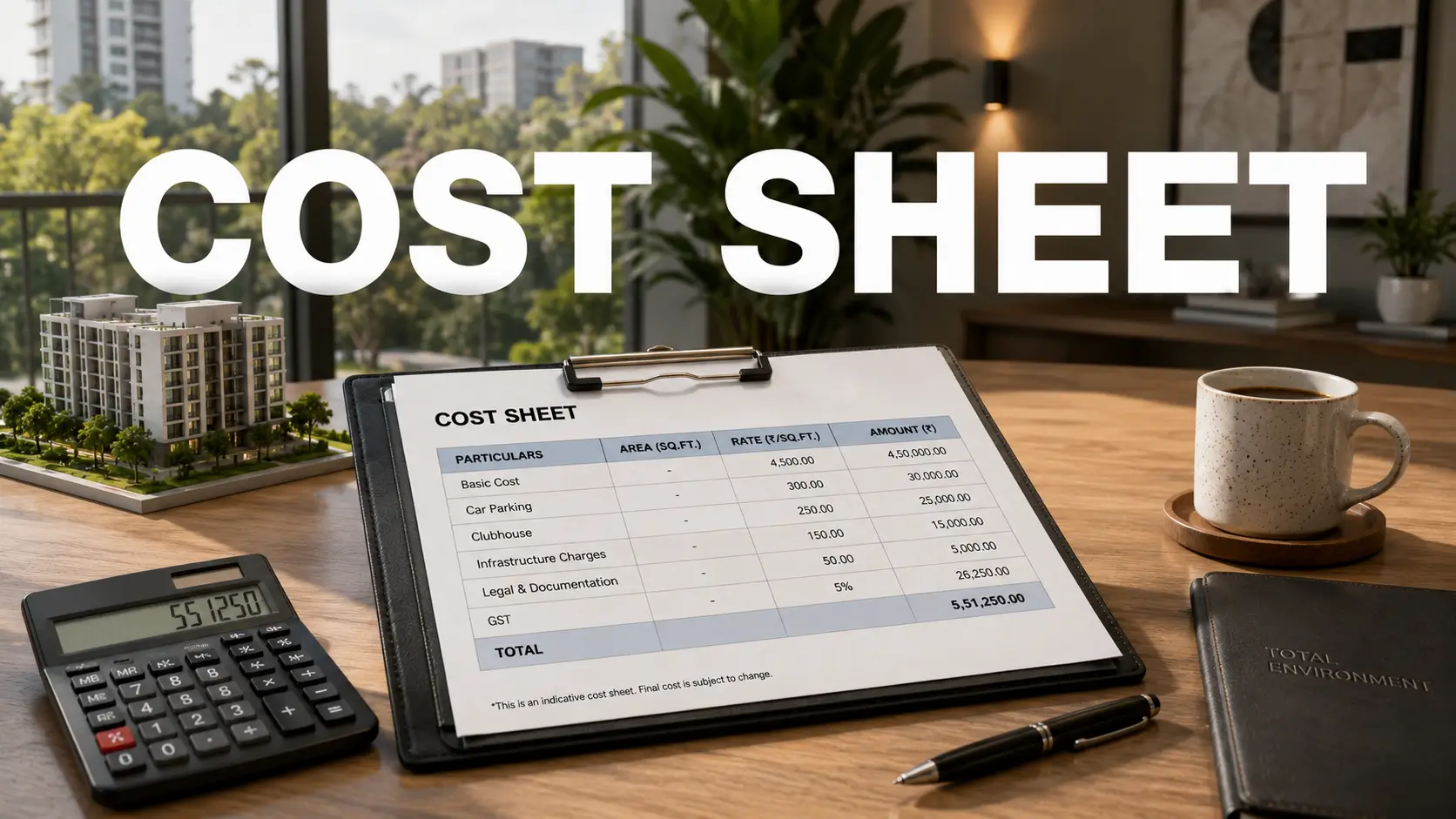
Embassy South Reserve Cost Sheet: Every Line Explained
Rs 1.92 Cr buys a 2 BHK here, or so the headline says. What leaves your account is another figure entirely, and the gap between the two runs to lakhs...

Checking the Embassy South Reserve RERA Registration
A registration number on a brochure proves very little by itself. Behind it sits a filing on a public portal, and that filing is what actually protects...