Rent is set by tenants rather than by landlords, which is why the honest answer to this question begins with who is renting. Along the northern...
Rent is set by tenants rather than by landlords, which is why the honest answer to this question begins with who is renting. Along the northern corridor, the tenant base looks different from the rest of the city: more corporate leases, more airport-linked roles and more households whose employer pays part of the bill. Estimating rent near Bangalore airport therefore means understanding that demand before applying any percentage. Here are the ranges, the drivers behind them, and the factors that push a specific home above or below the average.
The ranges by configuration
Applying corridor yields to current entry prices gives workable figures. A semi-furnished 2 BHK points to roughly Rs 56,000 to Rs 64,000 a month, while a 3 BHK reaches about Rs 80,800 to Rs 92,300.
Furnishing lifts both. A furnished 2 BHK moves to around Rs 64,000 to Rs 72,000, and a furnished 3 BHK to roughly Rs 92,300 to Rs 1,03,900 a month.
Apply those bands to your own purchase price rather than to a headline figure. Estimating rent near Bangalore airport works best from the all-in cost, since that is what your capital actually committed.
Those figures assume a stabilised market rather than the first leasing cycle. Early rents in a new development frequently settle below the eventual level.
| Configuration | Size | Semi-furnished | Furnished |
|---|---|---|---|
| 2 BHK | 1,330–1,333 sft | Rs 56,000 – 64,000 | Rs 64,000 – 72,000 |
| 2.5 BHK | 1,598 sft | Rs 66,800 – 76,300 | Rs 76,300 – 85,900 |
| 3 BHK | 1,896–1,923 sft | Rs 80,800 – 92,300 | Rs 92,300 – 1,03,900 |
| 3.5 BHK | 2,140–2,250 sft | On price confirmation | On price confirmation |
Who is looking to rent
The tenant profile on the corridor is unusually diverse. Aerospace and defence staff work at the KIADB Aerospace SEZ about 10 km away, financial services professionals at IFCI Financial City around 8 km, and IT employees at Devanahalli Business Park roughly 11 km out.
Airport and airline staff form a further group, drawn by a terminal about 14 km away. Each of these cohorts values proximity differently, which spreads demand across configurations.
Company-leased housing changes negotiating dynamics. Where an employer pays, security, amenity and address often matter more than shaving a few thousand rupees off a monthly figure.
Seniority shapes the tenant mix as much as sector does. Junior staff take smaller homes and move more often, while senior hires settle into larger ones for longer.
Airport-linked roles create a distinctive pattern of demand. Cabin crew, ground staff and airline management value proximity in a way office workers rarely do.
Tenant preferences shift over time as well. What let easily five years ago may sit longer today, which is why periodic market checks matter.
What lifts a rent above the band
Several factors count among what drives premium rents. Higher floors with longer views generally lease above lower ones, and homes with better light attract stronger interest.
Amenity depth matters for corporate tenants in particular. A clubhouse, pools, sports courts and security at township scale are difficult to match in a standalone building, and tenants price that difference.
Specification plays its part too. Ten-foot ceilings, engineered marble flooring and air conditioning fitted as standard distinguish a home from competing stock at viewing stage.
Security and gated access weigh heavily with relocating families. For tenants unfamiliar with a city, those assurances often outrank a modest rent difference.
Parking allocation influences rent more than many landlords expect. Tenants with two cars will pay for a home that accommodates both.
Photographs of the actual home, rather than a show flat, build trust with prospective tenants and reduce wasted viewings considerably.
Furnishing decisions
Furnishing and rent levels move together, though not proportionately. The step from semi-furnished to furnished adds roughly half a percentage point of yield rather than a dramatic uplift.
Corporate tenancies usually justify the outlay, since executives relocating want a home ready to occupy. Family tenancies often prefer unfurnished or semi-furnished, because they bring their own possessions.
Unfurnished lets suit long family tenancies best. Households bringing their own furniture usually stay longer, which reduces turnover costs for a landlord.
Partial furnishing is a middle path worth considering. Appliances and wardrobes without full furniture often capture much of the uplift at lower cost.
Storage and wardrobes influence decisions more than most landlords realise. Tenants notice practical details during a viewing.
Vacancy and leasing cycles
Vacancy and leasing cycles deserve a line in every model. Smaller configurations typically clear faster in a corporate market, while larger homes take longer but command higher rents.
New developments also take time to stabilise. Early tenants often negotiate harder, and rents usually firm once the surrounding area fills and amenities operate fully.
A sensible model therefore assumes some void periods rather than continuous occupancy from day one, particularly across the first leasing cycle.
Leasing seasons follow corporate hiring cycles rather than the calendar. Activity tends to cluster around transfer windows and the start of financial years.
Marketing a home well shortens vacancy. Good photographs, accurate listings and prompt responses matter as much on the rental market as on the sales one.
Void periods hurt more than a modest rent reduction does. A month empty costs more than a small discount spread across a year.
Timing matters most
None of this applies before possession in 2032. Homes here are under construction, so a landlord should plan for six years of outgoings without offsetting income.
Market conditions in 2032 will differ from today's, and rent bands should be treated as directional rather than fixed. Our team can share current leasing evidence from comparable stock if that helps you plan.
Rent bands will shift by 2032 in ways nobody can model precisely. Treat today's figures as a reference point rather than a projection.
Our team can share what comparable completed projects nearby are currently achieving, which grounds any projection in evidence.
Ask us to advise on furnishing levels for the tenant profile you are targeting rather than a generic standard.
Let the numbers guide the decision rather than an aspiration about what a home ought to earn.
Karnataka RERA Registration No. PRM/KA/RERA/1251/309/PR/090926/008925. To check availability, current pricing or to arrange a site visit, get in touch with our team.
FAQs
What can a 2 BHK earn?
Roughly Rs 56,000 to Rs 64,000 a month semi-furnished, or Rs 64,000 to Rs 72,000 furnished.Who are the likely tenants?
Staff from aerospace, financial services, IT and airport-services employers, many on company-leased budgets.Does furnishing raise rent much?
It adds around half a percentage point of yield, which suits corporate tenancies better than long family lets.Which homes let fastest?
Smaller configurations typically clear quicker, while larger homes take longer but earn more.When can I start letting?
After possession in 2032, since the homes are under construction until then.What lifts rent above the band?
Higher floors, better light, amenity depth and specification such as ten-foot ceilings and fitted air conditioning.Should I allow for vacancy?
Yes, particularly in the first leasing cycle while the surrounding area fills.Are these figures guaranteed?
No. They are indicative expectations for a stabilised market rather than assured returns.
Related Articles

Embassy South Reserve Review: An Honest Assessment
Nobody lives here yet, and possession is set for 2032, so any Embassy South Reserve review has to work from documents rather than experience. That...

The Embassy South Reserve Booking Process, Step by Step
Buying a home is a sequence of decisions rather than a single one, and knowing the order keeps control where it belongs. Expression-of-interest holders...
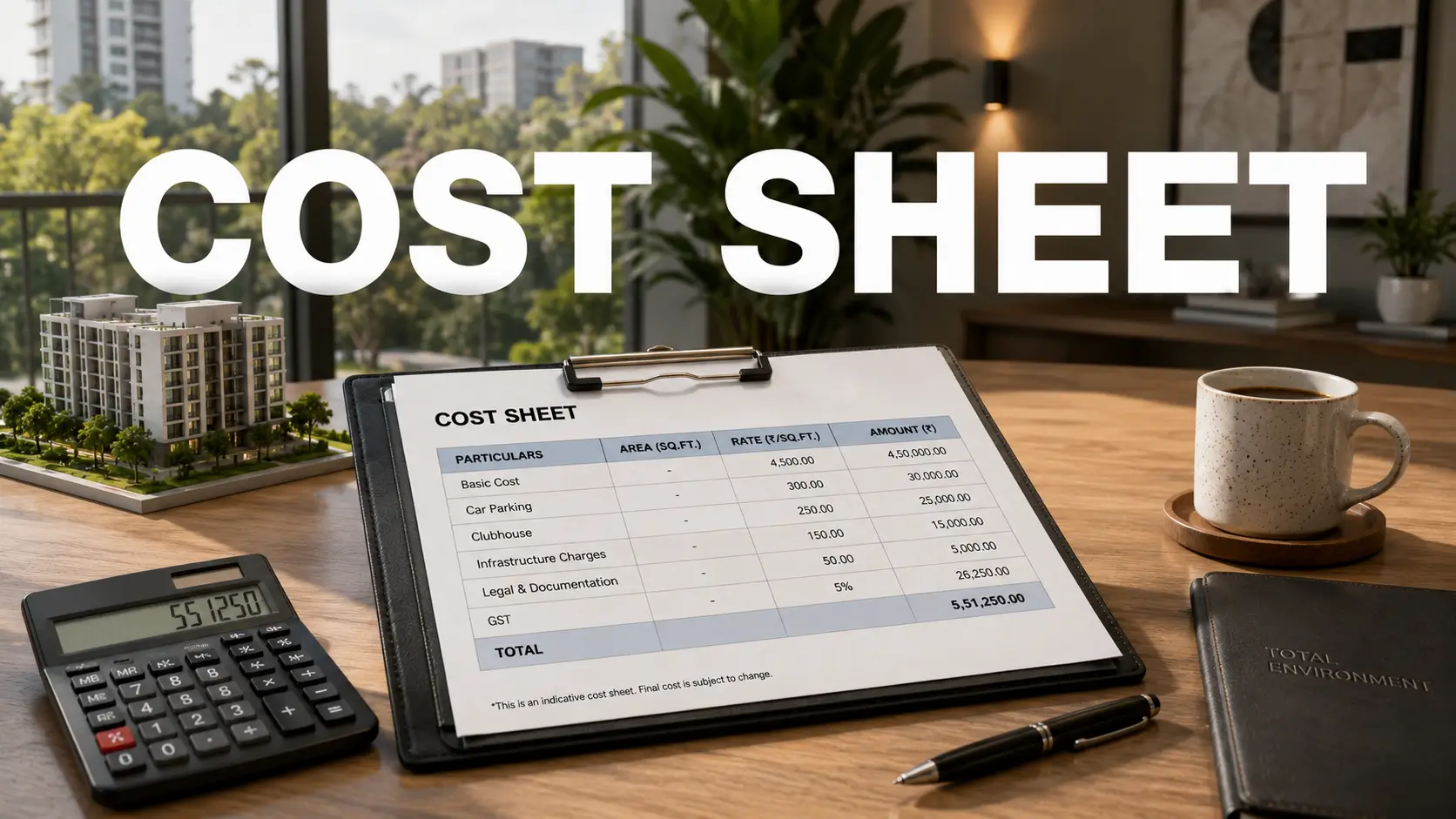
Embassy South Reserve Cost Sheet: Every Line Explained
Rs 1.92 Cr buys a 2 BHK here, or so the headline says. What leaves your account is another figure entirely, and the gap between the two runs to lakhs...

Checking the Embassy South Reserve RERA Registration
A registration number on a brochure proves very little by itself. Behind it sits a filing on a public portal, and that filing is what actually protects...