
Buyers budget carefully for a base price and are then surprised by what sits on top of it. Statutory charges alone add more than a tenth to most...
Buyers budget carefully for a base price and are then surprised by what sits on top of it. Statutory charges alone add more than a tenth to most purchases, and they cannot be financed the way a purchase price can. Understanding stamp duty on flats in Karnataka, alongside registration and GST, turns an unpleasant surprise into a planned expense. This guide covers what each charge is, how it is calculated, when it falls due and how the total lands for homes in this price band.
What stamp duty is
Stamp duty is a state levy on the instrument that transfers property, and a buyer pays it when registering the sale deed. Registration charges apply separately alongside it.
For homes in this ticket band, stamp duty and registration together come to roughly 7.65% of the consideration.
The state sets rates and concessions and revises them periodically, so confirm the position applying on your registration date rather than at booking.
Anyone budgeting for stamp duty on flats in Karnataka should treat the percentage as applying to a figure that may itself change before registration.
Duty is calculated on the instrument rather than on a buyer, which is why the rate applies regardless of who purchases.
Buyers occasionally assume duty is negotiable, which it is not, since the state sets the rate.
Charges of this kind apply to every purchase, which makes them predictable even when the exact figure is not.
Charge | Rate | When it falls due |
|---|---|---|
GST | 5% on under-construction homes | With construction milestones |
Stamp duty and registration | ~7.65% for this ticket band | At registration |
Club membership | Per the cost sheet | One-time, usually at booking |
Maintenance corpus | Per the cost sheet | One-time, usually at booking |
Floor rise and preferred location | Per the cost sheet | With the purchase consideration |
Khata, legal and documentation | Per the cost sheet | Around registration |
How guidance value works
Guidance value at registration is the basis for calculation. The state publishes minimum values for property by area, and the applicable figure determines the duty.
That matters for under-construction purchases in particular, since registration happens years after booking. Guidance values can change in the interim.
Build a margin into your budget rather than treating today's percentage applied to today's price as a fixed future number.
Registration and stamp duty fall due together, which concentrates a substantial payment at one point near handover.
Values published by the state can rise between booking and registration, particularly across a long construction period.
Guidance values are revised periodically by area, so the figure applying at registration is what counts.
Budgeting on today's guidance value with a margin is more prudent than assuming it will hold for six years.
GST on under-construction homes
GST on under-construction homes runs at 5%, arriving alongside construction milestones rather than at a single point.
Completed properties follow different rules, which is one reason a ready home and an under-construction one at the same headline price rarely compare directly.
Lenders rarely fund either GST or stamp duty, which means both come from a buyer's own resources.
Ready properties follow different treatment, which is worth factoring into any comparison between the two routes.
Milestone-linked GST also spreads that charge across several financial years rather than concentrating it.
Ready homes attract no GST, which narrows the apparent price gap between the two routes.
Comparing a ready home with an under-construction one therefore requires two complete models rather than two prices.
What the total looks like
Adding statutory charges to entry prices at South Reserve gives workable figures. A 2 BHK at Rs 1.92 Cr reaches roughly Rs 2.16 Cr once GST and stamp duty come on top.
Applying the same basis, a 2.5 BHK at Rs 2.29 Cr comes to about Rs 2.58 Cr and a 3 BHK at Rs 2.77 Cr to approximately Rs 3.12 Cr.
Those totals still exclude floor rise, preferred location charges, club membership, corpus, parking and legal costs, all of which sit on the cost sheet.
Charges beyond tax vary by unit, since floor rise and preferred location attach to specific apartments rather than to configurations.
Two identically sized homes can therefore carry different totals depending on floor, orientation and tier.
Parking, khata and documentation charges also vary between developments rather than following a standard schedule.
Cost sheets differ by unit, which is why a generic price list cannot answer what a particular home will cost.
When each charge falls due
Knowing when each charge falls due matters for cash flow. GST arrives with milestones through construction, while stamp duty and registration wait until the sale deed is registered near handover.
Club membership and the corpus contribution usually fall due once at booking, which front-loads the first few months of outflow.
Spacing of that kind helps, though it also leaves a large payment at the end, years after most buyers stopped thinking about it.
Planning for that final payment years in advance avoids an unwelcome scramble when the sale deed is ready.
Keeping a note of expected charges and their timing makes the final year considerably less stressful.
Setting money aside gradually through construction is easier than finding it in a single month near handover.
Registration typically happens close to handover, so the final payment arrives years after booking.
Budgeting properly
Budgeting for the all-in cost rather than the base price is the single most useful habit a buyer can adopt. The difference exceeds a tenth of the purchase before other charges.
Ask for the cost sheet covering your specific unit, which should show carpet-area pricing alongside every charge under K-RERA disclosure rules.
Confirm the current rates with a professional close to registration, since state levies change and the figure applying then is what you will actually pay.
Ask for the sheet covering your exact unit rather than a generic version circulated to every enquiry.
Carpet-area pricing disclosure under K-RERA rules also lets you compare projects on the same basis.
Professional confirmation close to registration is worth obtaining, since rates and values both change.
Our team can produce the sheet for any unit you shortlist so the figures are specific rather than indicative.
Karnataka RERA Registration No. PRM/KA/RERA/1251/309/PR/090926/008925. To check availability, current pricing or to arrange a site visit, get in touch with our team.
FAQs
What is the stamp duty rate?
Stamp duty and registration together come to roughly 7.65% for homes in this ticket band in Karnataka.When is it paid?
At registration of the sale deed, which for an under-construction home happens close to handover.What is guidance value?
A minimum value published by the state for property in an area, used as the basis for calculating duty.Does GST apply as well?
GST of 5% applies to under-construction homes and is charged alongside construction milestones.Can these charges be financed?
Lenders generally fund the consideration rather than the tax, so both usually come from your own resources.What does a 3 BHK cost all-in?
About Rs 3.12 Cr on a Rs 2.77 Cr base price once GST and stamp duty are added, before other charges.What else appears on the cost sheet?
Floor rise, preferred location charges, club membership, maintenance corpus, parking, khata and legal costs.Do rates change?
State levies are revised periodically, so confirm the position applying at your registration date.
Related Articles

Embassy South Reserve Review: An Honest Assessment
Nobody lives here yet, and possession is set for 2032, so any Embassy South Reserve review has to work from documents rather than experience. That...

The Embassy South Reserve Booking Process, Step by Step
Buying a home is a sequence of decisions rather than a single one, and knowing the order keeps control where it belongs. Expression-of-interest holders...
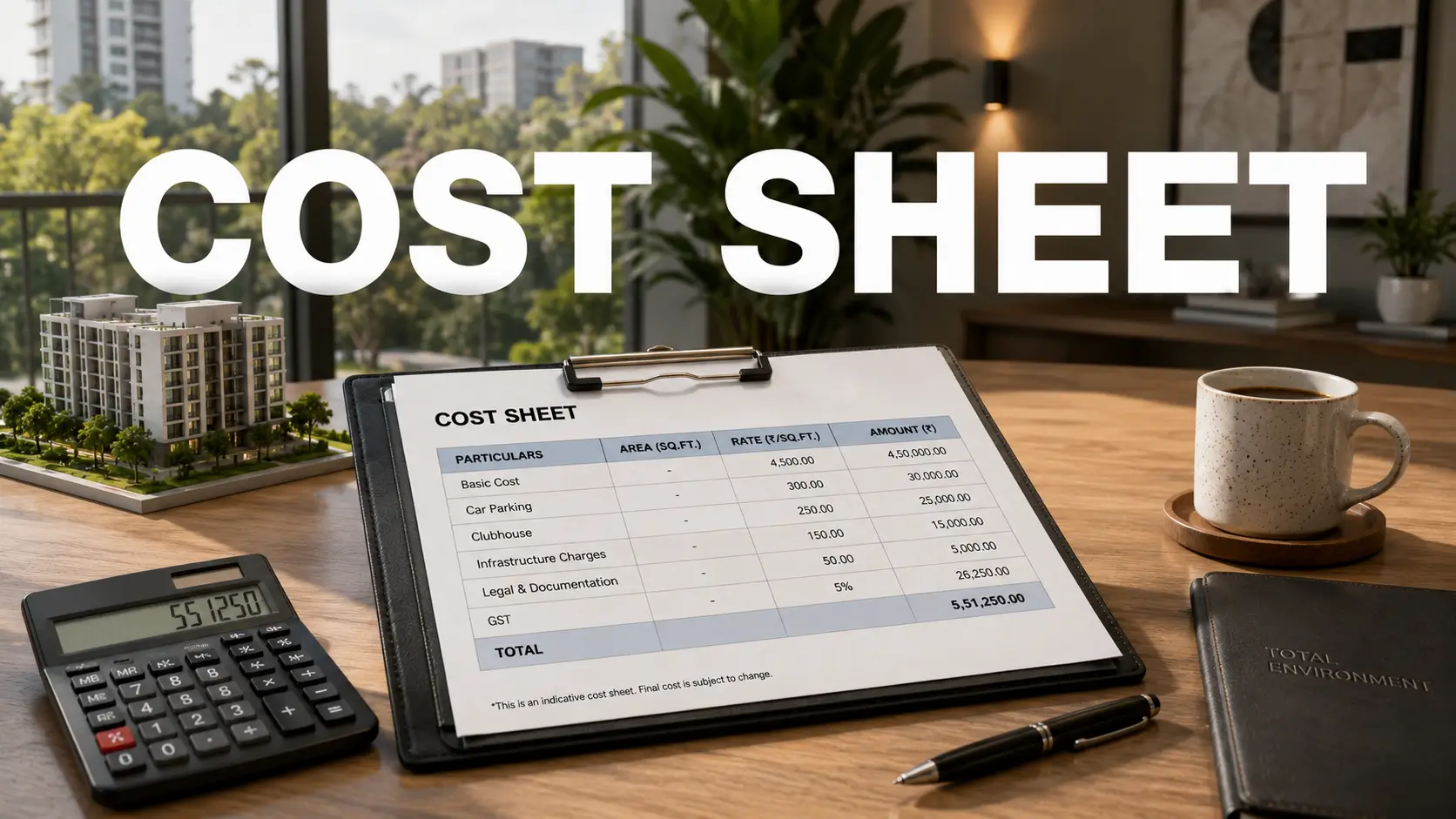
Embassy South Reserve Cost Sheet: Every Line Explained
Rs 1.92 Cr buys a 2 BHK here, or so the headline says. What leaves your account is another figure entirely, and the gap between the two runs to lakhs...

Checking the Embassy South Reserve RERA Registration
A registration number on a brochure proves very little by itself. Behind it sits a filing on a public portal, and that filing is what actually protects...