
Most homebuyers have never needed to understand a real estate investment trust, and normally they would not. The structure becomes relevant here...
Most homebuyers have never needed to understand a real estate investment trust, and normally they would not. The structure becomes relevant here because the developer behind a residential project also sponsors one, which says something about the standards its commercial assets meet. Explaining what is Embassy REIT therefore serves a practical purpose rather than an academic one. This guide covers how such trusts work, what sponsorship requires, and what an institutional structure does and does not tell a person buying an apartment.
How these trusts work
Real estate investment trust basics are simple enough. A trust owns income-producing property, collects rent from tenants and distributes most of that income to unit holders who trade on an exchange.
Investors gain exposure to large commercial property without buying a building. Instead of owning one office floor, they own a small share of a portfolio.
Regulation governs how such trusts operate, including what they may own, how much they may borrow and how much income they must distribute.
Understanding what is Embassy REIT helps a buyer interpret the developer rather than the trust itself, which is where its relevance genuinely lies.
Trust structures separate ownership from management, which introduces oversight that privately held portfolios do not automatically carry.
Institutional structures bring transparency that private ownership rarely matches, since reporting is mandatory rather than discretionary.
Sponsorship differs from ownership. A sponsor contributes assets and remains associated rather than retaining outright control.
Retail investors can access commercial property through such vehicles without the capital a building would require, which is the structure's original purpose.
Aspect | Detail |
|---|---|
Structure | Trust owning income-producing commercial property |
Investors | Unit holders trading on an exchange |
Income | Largely distributed rather than retained |
Embassy connection | Sponsor of India's first REIT |
Scale | Asia Pacific's largest by area |
Relevance to buyers | Indicates institutional-grade commercial assets |
The Embassy connection
The group sponsors India's first real estate investment trust, which is also Asia Pacific's largest by area. Sponsorship means contributing assets and remaining associated with the structure.
Assets entering such a vehicle must satisfy institutional requirements rather than merely attracting tenants. Standards for construction, documentation and operations all apply.
Distribution requirements shape how these vehicles behave, favouring stable income-producing assets over speculative development.
Exchange listing also means unit prices reflect continuous market assessment of the underlying assets and their management.
Unit holders can exit by selling on an exchange, which is a very different proposition from owning a building directly.
What institutional standards require
Institutional standards for assets differ from those a typical buyer encounters. Investors assess title, approvals, tenant quality, lease structures, building systems and maintenance history before committing capital.
Ongoing scrutiny follows the initial diligence. Listed vehicles report periodically, and their portfolios are examined continuously by analysts and investors alike.
Assets that fail those tests do not enter or remain within such structures, which makes inclusion a meaningful signal rather than a promotional one.
Tenant quality forms part of institutional assessment. Long leases with substantial occupiers are valued more highly than short ones with weaker covenants.
Documentation standards are unusually high in institutional transactions, covering title, approvals and lease structures in detail.
Portfolio quality is assessed continuously rather than once, which sustains pressure on management over years.
Lease lengths and tenant covenants both feed into how institutional investors value a portfolio.
Reporting obligations also mean performance is published rather than described, which changes the quality of information available.
The commercial portfolio behind it
Commercial portfolio backing gives the structure substance. Embassy Manyata Business Park serves more than 80,000 professionals, with Embassy Tech Village and Embassy GolfLinks alongside it.
Campuses of that scale require operational systems, maintenance regimes and service standards sustained over decades rather than delivered once at handover.
Operating large campuses requires systems that function daily across decades rather than looking impressive at opening.
Service levels at large campuses are measured and reported, which creates habits that carry into residential operations.
Energy and water management at campus scale also inform how a township approaches sustainability.
What it signals to buyers
Considering what it signals to buyers, the connection is indirect but real. A developer whose commercial assets meet institutional requirements has demonstrated capability in construction and operations.
Residential projects do not sit inside the trust, and buyers of apartments have no relationship with it. The signal concerns the developer rather than the home.
Operational discipline is the transferable element. Maintenance, security and building services learned on commercial campuses inform how a township is run after handover.
Skills transfer between commercial and residential operations within one organisation, particularly in maintenance and security.
Buyers should still focus on their own project's filings, since that is where their rights and remedies actually sit.
Security, housekeeping and technical staffing at campus scale all require systems that translate directly to township operations.
Common-area maintenance at scale is a discipline in itself, and one that few purely residential developers practise.
Vendor management at campus scale also transfers usefully, since the same contractors often serve both portfolios.
What it does not mean
No guarantee attaches to a residential project because of REIT sponsorship. Delivery timelines, specification and quality still depend on the individual development.
Verification remains a buyer's responsibility. Karnataka RERA registration, sanctioned plans and quarterly progress filings apply to your project specifically.
Our team can explain the structure and where its relevance ends, which is usually more useful than treating it as a general endorsement.
Separate the signal from the guarantee. One is genuinely informative; the other does not exist.
Ask what the structure does and does not cover, and be cautious of anyone presenting it as a warranty.
Keep the distinction clear in your own mind. A signal about capability is useful; a guarantee about your apartment does not exist.
Read the structure for what it indicates rather than for comfort it cannot provide.
Interpretation matters as much as information when weighing signals of this kind.
Karnataka RERA Registration No. PRM/KA/RERA/1251/309/PR/090926/008925. To check availability, current pricing or to arrange a site visit, get in touch with our team.
FAQs
What is a REIT?
A trust owning income-producing commercial property, distributing most of its rental income to unit holders who trade on an exchange.What is the Embassy connection?
The group sponsors India's first real estate investment trust, which is also Asia Pacific's largest by area.Does my apartment sit inside the trust?
No. Residential projects are separate, and apartment buyers have no relationship with the structure.Why does it matter to a homebuyer?
It indicates that the developer's commercial assets meet institutional standards for construction and operations.Which assets back it?
Commercial campuses including Embassy Manyata Business Park, which serves more than 80,000 professionals.Is it a guarantee of quality?
No. Each residential project should still be assessed through its own RERA filing and documents.Are REITs regulated?
Yes. Rules govern what they may own, how much they may borrow and how much income they must distribute.Can I invest in one?
Units trade on an exchange, so they are accessible to investors, though that is separate from buying an apartment.
Related Articles

Embassy South Reserve Review: An Honest Assessment
Nobody lives here yet, and possession is set for 2032, so any Embassy South Reserve review has to work from documents rather than experience. That...

The Embassy South Reserve Booking Process, Step by Step
Buying a home is a sequence of decisions rather than a single one, and knowing the order keeps control where it belongs. Expression-of-interest holders...
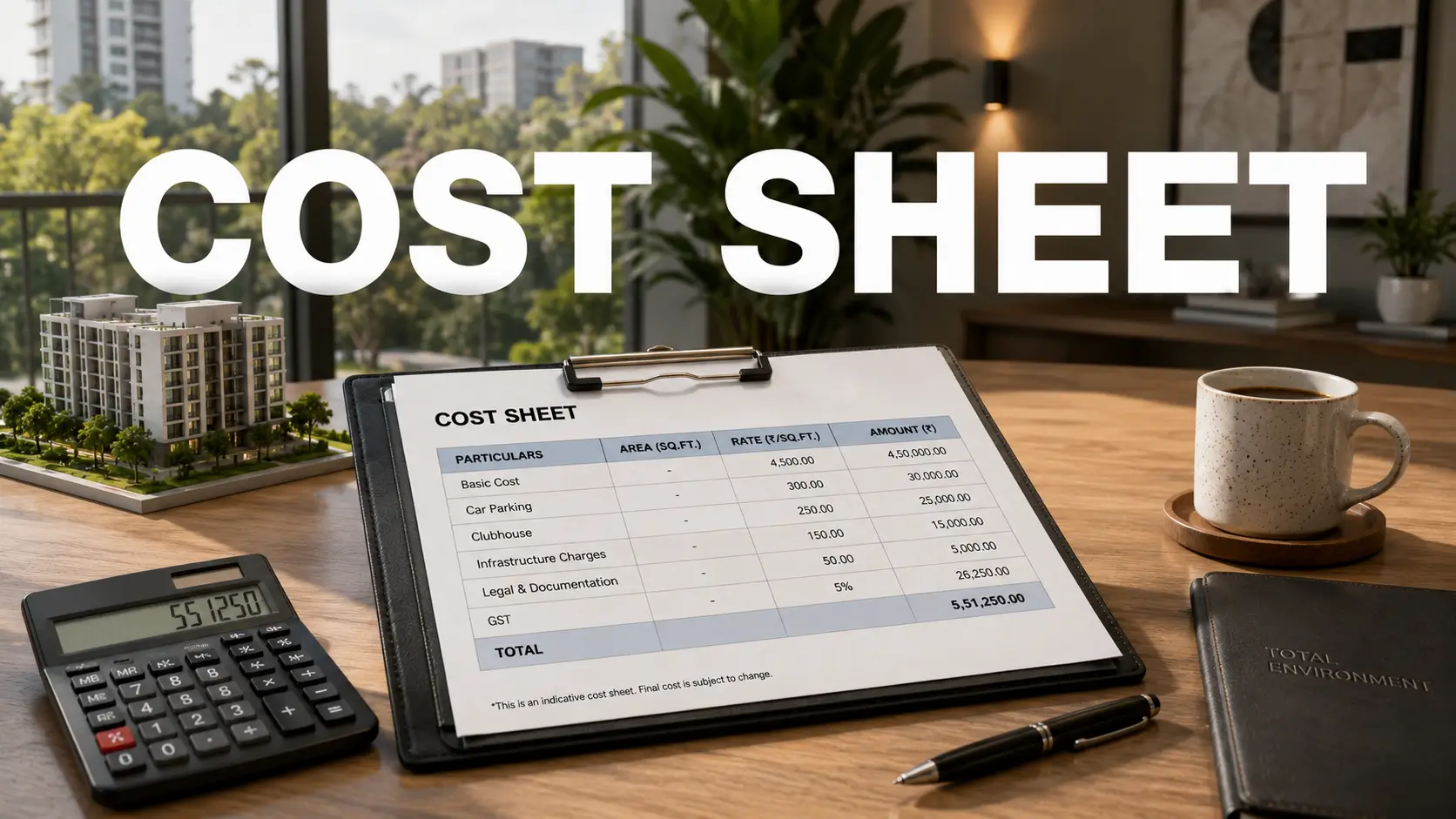
Embassy South Reserve Cost Sheet: Every Line Explained
Rs 1.92 Cr buys a 2 BHK here, or so the headline says. What leaves your account is another figure entirely, and the gap between the two runs to lakhs...

Checking the Embassy South Reserve RERA Registration
A registration number on a brochure proves very little by itself. Behind it sits a filing on a public portal, and that filing is what actually protects...