Green certification appears on a great many project brochures, usually without much explanation of what it involves. The distinction between a rating...
Green certification appears on a great many project brochures, usually without much explanation of what it involves. The distinction between a rating targeted and a rating achieved matters especially, since only one of them has been assessed. Explaining what is IGBC Green Homes Gold therefore means covering the rating system, the systems that earn it and the difference between intention and certification. This guide sets out what the standard covers, which provisions apply at South Reserve, and what green design actually changes for a resident.
The rating system
The Indian Green Building Council operates a certification programme for residential developments, assessing projects against criteria covering energy, water, materials and site practices.
Green building certification levels rise in stages, with Gold sitting towards the upper end of the scale. Higher ratings require more extensive provisions across a greater number of categories.
Certification is awarded on assessment rather than on application. A project must demonstrate compliance rather than merely describe an intention.
Certification programmes vary between countries and between schemes. Knowing what is IGBC Green Homes Gold specifically avoids confusing it with other ratings.
Certification schemes evolve as standards rise, so criteria applied today differ from those applied a decade ago.
Ratings apply to a specific project rather than to a developer generally, so confirm which development any claim refers to.
Levels within the rating allow meaningful comparison between projects rather than a single pass or fail.
Assessment covers design and construction together, so a project pursuing certification builds differently from one that is not.
Target versus certification
Target versus certification is the distinction buyers most often miss. A project working towards a rating has not yet received it, whatever a brochure implies.
At South Reserve, IGBC Green Homes Gold is the stated certification target for the apartment parcel. Confirmation would follow assessment rather than accompany the launch.
Read project material carefully on this point. Words such as targeted, designed to or working towards all describe intention rather than achievement.
Assessment happens against documented evidence rather than a site impression, which is why the distinction between target and award matters.
Independent assessment is what gives a rating value. Self-declared green credentials carry considerably less weight.
Scoring covers site practices during construction as well as the finished building, which affects how a project is actually built.
Provision | Detail |
|---|---|
Certification | IGBC Green Homes Gold, stated as a target |
Hot water | Solar-based systems |
Water | Rainwater harvesting and zero-discharge planning |
Waste | Organic waste converter for wet waste on site |
Treatment | Sewage and water treatment per KSPCB, BWSSB and MoEF guidelines |
Consumption | Optimised per National Building Code recommendation |
Water and waste systems
Water and waste systems carry much of the weight in any green rating. Rainwater harvesting captures monsoon runoff, and zero-discharge planning aims to prevent treated water leaving the site unused.
An organic waste converter processes wet waste within the development rather than sending it elsewhere. Sewage and water treatment infrastructure follows KSPCB, BWSSB and MoEF guidelines.
Water consumption is optimised per National Building Code recommendation, which addresses demand alongside supply and treatment.
Monsoon capture makes rainwater harvesting particularly effective in this region, where rainfall concentrates across a few months.
Zero-discharge planning aims to reuse treated water on site rather than releasing it, which reduces demand on municipal supply.
Water security matters increasingly in Bangalore, which gives harvesting and reuse provisions practical rather than symbolic value.
Treated water reused for landscape irrigation reduces demand on municipal supply throughout the year.
Rainfall in this region concentrates across a few months, which makes storage capacity as important as collection area.
Energy provisions
Solar-based hot water systems reduce electricity demand for a load that operates daily across every home in a development.
Common-area power backup at 100%, with selected unit-load support, addresses reliability rather than efficiency, though the two often feature together in specification discussions.
Backup provision and efficiency address different problems. Both belong in a specification, though only one contributes to a green rating.
Solar hot water suits Bangalore's climate particularly well, given consistent sunshine across much of the year.
Efficiency measures reduce demand rather than merely adding backup, and the distinction matters when comparing projects.
What it changes for residents
Running costs for residents are where green provisions become tangible. Solar hot water and optimised consumption reduce demand on utilities, which feeds into monthly outgoings over time.
On-site waste processing keeps a development cleaner and less dependent on external collection, which matters in a township of this scale.
Systems built in at construction stage operate as defaults rather than retrofits. Adding them later is considerably more expensive and often impractical.
Township-scale systems generally outperform building-scale ones, since treatment and processing become viable at larger volumes.
Waste processing on site also reduces vehicle movements through a township, which benefits residents in ways rarely counted.
Certification also requires documentation throughout construction, which imposes discipline on how a project is built and recorded.
Waste segregation at source is required for on-site processing to work, which involves residents as well as systems.
Resident participation determines how well some systems perform, particularly waste segregation at household level.
What to verify
Ask whether certification has been awarded or remains a target, and request written confirmation of the current position rather than relying on marketing language.
Check that green provisions appear in the specification schedule attached to the agreement. Under RERA, marketed specifications must match sanctioned ones.
Our team can set out which systems are specified and which remain subject to certification, which is a clearer answer than a logo on a brochure.
Written confirmation is worth requesting on any certification claim, whatever the project.
Treat a target as an intention and a certificate as an outcome, and ask which one applies.
Ask when assessment is expected and what happens if the target level is not achieved.
Written answers on certification status are worth more than a logo on a hoarding.
Ask for the current certification position in writing before treating any rating as achieved.
Karnataka RERA Registration No. PRM/KA/RERA/1251/309/PR/090926/008925. To check availability, current pricing or to arrange a site visit, get in touch with our team.
FAQs
What is IGBC?
The Indian Green Building Council, which operates a certification programme assessing developments on energy, water, materials and site practices.Where does Gold sit?
Towards the upper end of the rating scale, requiring more extensive provisions than lower levels.Is this project certified?
IGBC Green Homes Gold is stated as the target for the apartment parcel, which is different from an awarded certification.What water systems are provided?
Rainwater harvesting, zero-discharge planning and treatment infrastructure following KSPCB, BWSSB and MoEF guidelines.How is waste handled?
An organic waste converter processes wet waste on site, alongside structured waste segregation.Is hot water solar powered?
Solar-based hot water systems are specified.Does green design reduce bills?
It reduces demand on utilities, which feeds into running costs over time.How do I confirm the status?
Ask for written confirmation of whether certification has been awarded, and check the specification schedule in the agreement.
Related Articles

Embassy South Reserve Review: An Honest Assessment
Nobody lives here yet, and possession is set for 2032, so any Embassy South Reserve review has to work from documents rather than experience. That...

The Embassy South Reserve Booking Process, Step by Step
Buying a home is a sequence of decisions rather than a single one, and knowing the order keeps control where it belongs. Expression-of-interest holders...
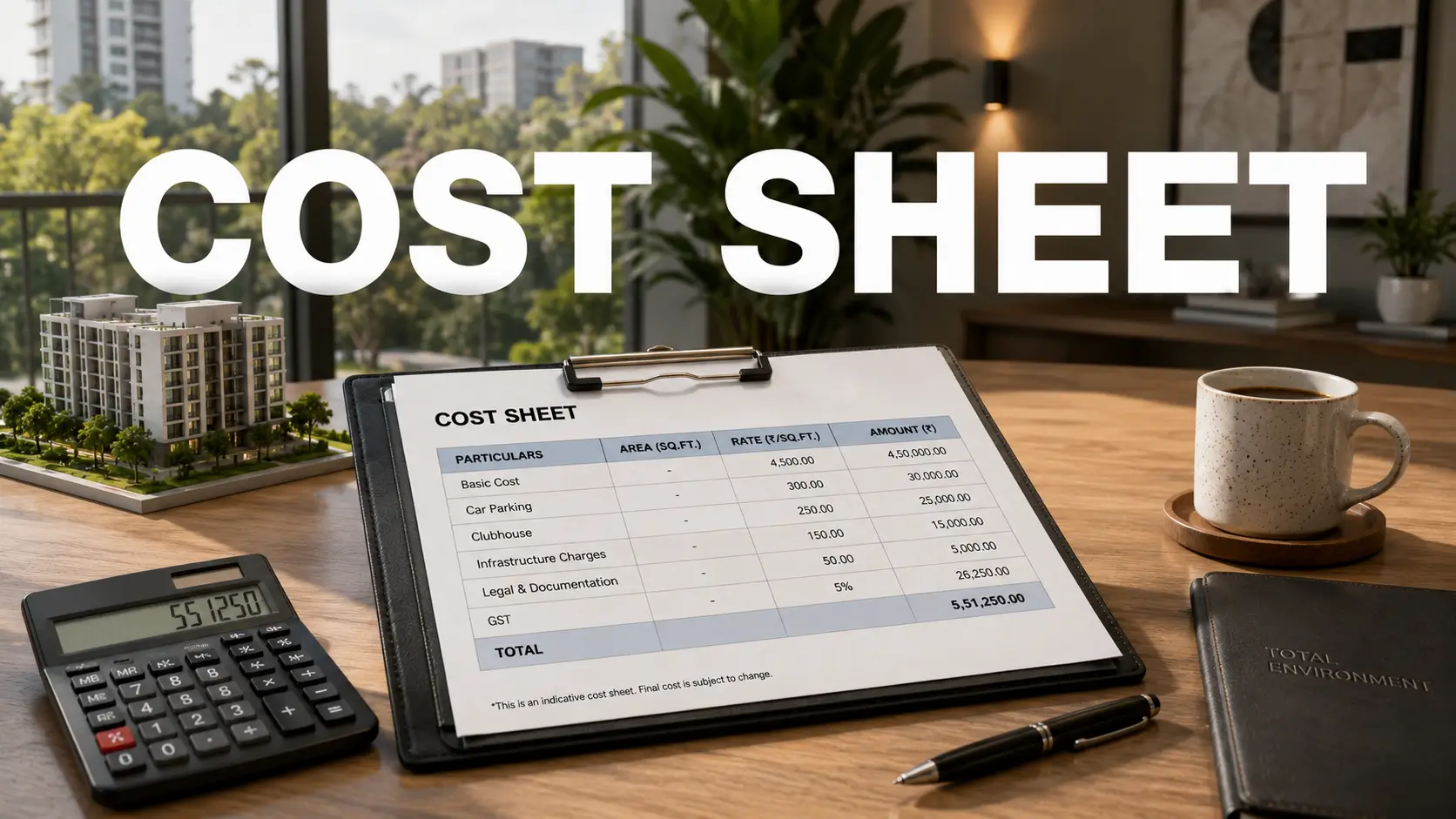
Embassy South Reserve Cost Sheet: Every Line Explained
Rs 1.92 Cr buys a 2 BHK here, or so the headline says. What leaves your account is another figure entirely, and the gap between the two runs to lakhs...
Checking the Embassy South Reserve RERA Registration
A registration number on a brochure proves very little by itself. Behind it sits a filing on a public portal, and that filing is what actually protects...