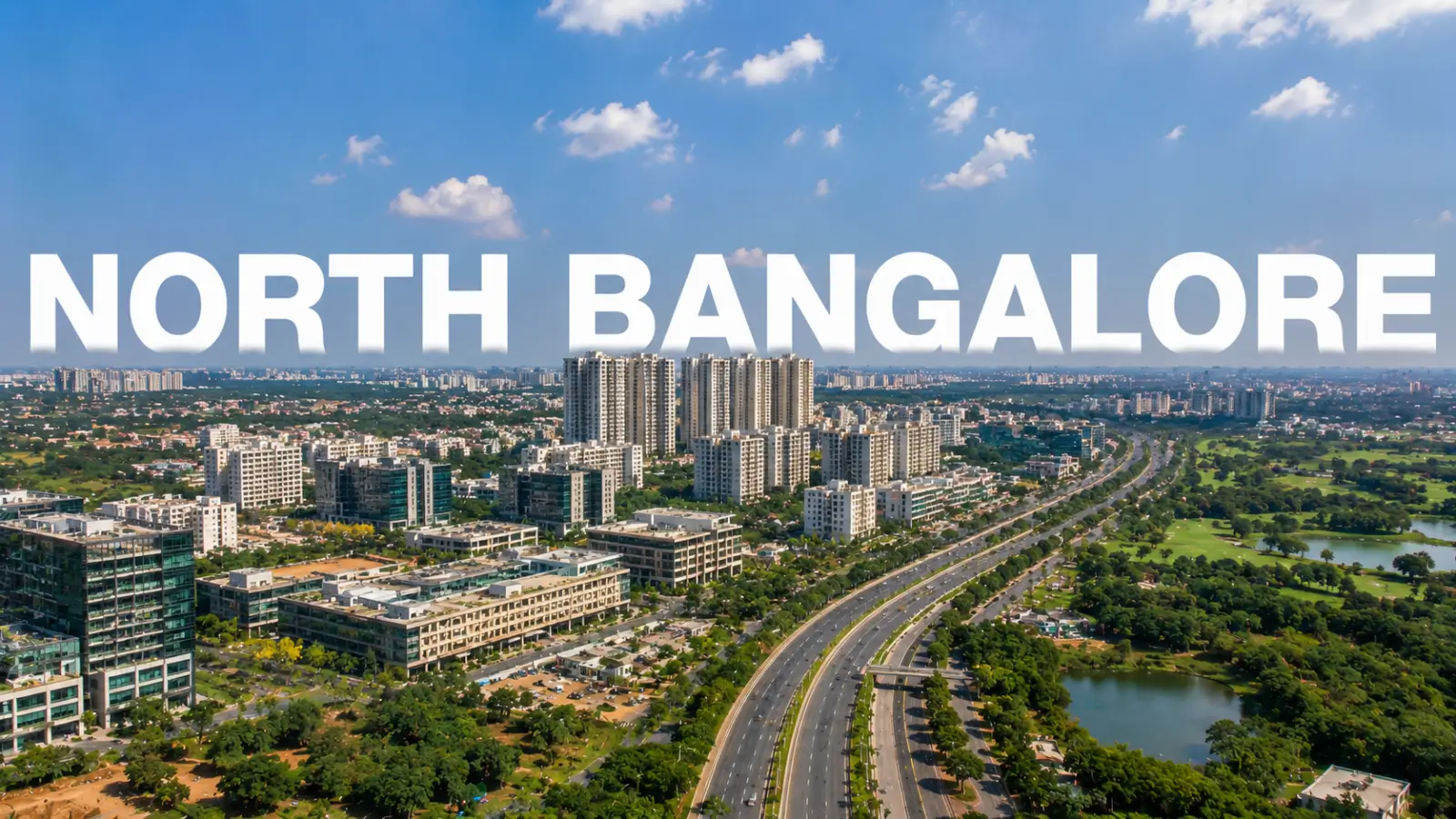
Every corridor in a large city has its advocates, and most arguments for one over another rest on anecdote rather than evidence. The case for the...
Every corridor in a large city has its advocates, and most arguments for one over another rest on anecdote rather than evidence. The case for the northern belt can be made from figures instead. Asking why invest in North Bangalore therefore means comparing growth records, employment depth and infrastructure against the alternatives, then stating the risks with equal clarity. This guide sets out both sides, so the conclusion belongs to you rather than to anyone selling property there.
The growth record
Returns against other corridors provide the starting point. Between 2020 and 2026, the northern belt compounded at roughly 13.5% a year, ahead of Sarjapur Road at about 11%, Whitefield at about 10% and Electronic City at about 9%.
Shorter periods show the same direction. Appreciation ran at about 11.8% over one year, roughly 57% across three and around 73% across five.
Branded launches outpaced the index, adding roughly 20% through 2025, which reflects demand concentrating at the premium end of the market.
Ten-year figures reinforce the shorter windows, with appreciation of roughly 109% across that period.
Branded stock outperforming a general index also signals where demand is concentrating within a corridor.
Consistency across three, five and ten-year windows is what distinguishes a structural trend from a single strong year.
Percentage growth flatters lower-priced belts, so absolute rupee movement deserves a look alongside it.
Measure | North Bangalore |
|---|---|
Corridor average, Q1 2026 | ~Rs 9,500 per sft |
Premium and township launches | Rs 11,000–13,000 per sft |
One-year appreciation | ~11.8% |
Five-year appreciation | ~73% |
Compound growth, 2020–2026 | ~13.5% a year |
Projected, 2026 | ~12% |
Rental yield | 3.5–4% semi-furnished, 4–4.5% furnished |
Airport corridor advantages
Airport corridor advantages extend beyond convenience for travellers. Kempegowda International Airport sits about 14 km from the Tharahunise belt, a drive of roughly 20 to 25 minutes off-peak.
Proximity of that order attracts a distinct tenant and buyer group, including airline and airport-services staff alongside consultants and executives who travel weekly.
Airports also anchor commercial activity around them, from hospitality to logistics, which broadens the local economy beyond residential development.
Hospitality around the terminal adds further activity, from business hotels to serviced residences serving corporate travellers.
Logistics and cargo operations around a terminal generate employment that has nothing to do with passengers.
Frequent flyers convert a short airport run into hours saved each month, which is why the segment pays attention.
Ground handling, cargo and retail within the terminals employ substantial numbers independently of airline staff.
Employment depth
Four sectors operate within roughly 13 km of the belt. Aerospace and defence cluster at the KIADB Aerospace SEZ across some 3,000 acres, about 10 km away.
Financial services sit at IFCI Financial City around 8 km out, with IT at Devanahalli Business Park and manufacturing in the Devanahalli industrial zone at 11 to 13 km.
Depth of that kind supports both occupancy and resale, since demand does not depend on the fortunes of a single industry.
Employment depth also supports the rental case, which matters for anyone buying to let rather than to occupy.
Four sectors within thirteen kilometres is unusual for an outer belt, and it is the strongest part of the case.
Corporate leasing demand from those employers also supports occupancy once homes are handed over.
Aerospace, financial services, IT and manufacturing rarely slow simultaneously, which spreads risk across the catchment.
Infrastructure under way
Three transport projects are progressing. Doddajala Metro Station on the Phase 2B Blue Line sits about 7 km away, the Satellite Town Ring Road passes roughly 8 km north, and the Peripheral Ring Road corridor lies to the south-west.
None is in service yet, which is the honest position. Each should be treated as potential improvement rather than a benefit already reflected in daily life.
Existing roads carry the corridor today. NH-44 handles the airport run, with the Outer Ring Road reachable at about 18 km via Hebbal.
Existing connectivity already supports daily life, which is the sensible basis for any purchase decision here.
Ring roads under phased commissioning open in sections, so benefits arrive gradually rather than at once.
Buying for the network that exists today removes most of the risk attached to delivery timelines.
The Outer Ring Road remains reachable at about eighteen kilometres via Hebbal for trips across the city.
Risks to weigh
Risks to weigh deserve equal space. More than 15,000 units are planned across the wider Devanahalli belt, and absorption of that supply will test the market.
Distance from the city centre is the second. MG Road sits about 30 km away, taking 55 to 70 minutes off-peak, which rules the belt out for daily central commuting.
Infrastructure delivery is the third. Where the metro or ring roads slip, part of the expected benefit slips with them.
Entry pricing at the top of a corridor band also narrows the appreciation runway compared with buying lower.
Rental income also begins only after possession, which for under-construction homes here means 2032.
Charges beyond the base price also lift the real entry cost, which belongs in any return calculation.
Distance from the centre also limits the buyer pool at resale, which belongs in any honest assessment.
Who the belt suits
Considering who the belt suits produces a clear answer. Households working in the northern employment belt, frequent flyers and investors with a long horizon fit comfortably.
Buyers needing a central location, or expecting income within a year or two from an under-construction home, fit considerably less well.
Our team can compare specific projects here against alternatives elsewhere on rate, size and charges, which is usually more useful than a general case for any corridor.
Anyone weighing why invest in North Bangalore against another belt should run both through the same numbers rather than comparing a case for one against impressions of the other.
Horizon decides suitability more than any single figure in a comparison table.
Comparing two specific homes on rate, area, charges and commute settles more than any corridor-level argument.
Our team can run a specific project through the same comparison rather than arguing for a corridor in general.
Karnataka RERA Registration No. PRM/KA/RERA/1251/309/PR/090926/008925. To check availability, current pricing or to arrange a site visit, get in touch with our team.
FAQs
How has the corridor performed?
It compounded at roughly 13.5% a year between 2020 and 2026, ahead of Whitefield, Sarjapur Road and Electronic City.What do homes cost?
The corridor averaged around Rs 9,500 per sft in early 2026, with premium township launches at Rs 11,000–13,000.How far is the airport?
About 14 km from the Tharahunise belt, or 20 to 25 minutes off-peak.Which employers are nearby?
Aerospace and defence, financial services, IT and manufacturing, all within roughly 13 km.What rental yield is realistic?
Between 3.5 and 4% semi-furnished, and 4 to 4.5% furnished, once homes are let.What are the main risks?
Supply of more than 15,000 planned units, distance from the centre and infrastructure still under execution.Is it suitable for a central commute?
Not really. MG Road is about 30 km away, taking 55 to 70 minutes off-peak.Who does the belt suit?
Households working in northern employment, frequent flyers and investors holding across a full cycle.
Related Articles

Embassy South Reserve Review: An Honest Assessment
Nobody lives here yet, and possession is set for 2032, so any Embassy South Reserve review has to work from documents rather than experience. That...

The Embassy South Reserve Booking Process, Step by Step
Buying a home is a sequence of decisions rather than a single one, and knowing the order keeps control where it belongs. Expression-of-interest holders...
Embassy South Reserve Cost Sheet: Every Line Explained
Rs 1.92 Cr buys a 2 BHK here, or so the headline says. What leaves your account is another figure entirely, and the gap between the two runs to lakhs...

Checking the Embassy South Reserve RERA Registration
A registration number on a brochure proves very little by itself. Behind it sits a filing on a public portal, and that filing is what actually protects...